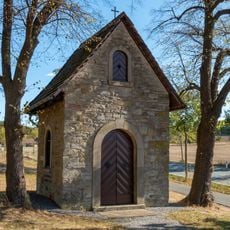
Gut Abbenburg, Manor estate in Bökendorf, Brakel, Germany
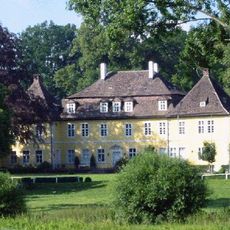
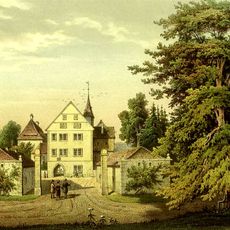
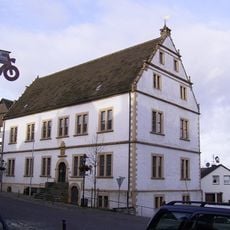
Gut Abbenburg is a former castle and manor estate in the Bökendorf district of Brakel. Its roughly square main island measures 75 to 80 m per side, with filled-in moats that once lay in front of ramparts. The main building in the southwest corner dates from 1598 and was completely remodelled in 1833; the gatehouse became a neo-Gothic tower in the 19th century, and the two Rentei buildings adjoin to the north.
In 1302 the counts of Schwalenberg and the Bishop of Paderborn agreed to build a castle and a town near the village of Abbenhusen; the castle was built, but no town was founded. The Abbenburg served as a regional castle of the Paderborn bishops until it was pledged to the von Asseburg family in 1336. In 1465 Gottschalk von Haxthausen was enfeoffed with the castle, which his family still owns.
Annette von Droste-Hülshoff spent several summers at Abbenburg between 1837 and 1845 with her step-uncle Fritz von Haxthausen. Events there inspired her novella "Die Judenbuche". The estate has belonged to the von Haxthausen family since Gottschalk von Haxthausen was enfeoffed with it in 1465.
The estate remains private property of the Haxthausen family and can be viewed externally from designated public areas. Access to the grounds themselves is limited, but the exterior architecture is visible from these viewpoints.
Annette von Droste-Hülshoff spent several summers at Abbenburg between 1837 and 1845 with her step-uncle Fritz von Haxthausen. Events there inspired her novella "Die Judenbuche", so the estate is tied to one of German literature's best-known crime stories.
The community of curious travelers
AroundUs brings together thousands of curated places, local tips, and hidden gems, enriched daily by 92,786 contributors worldwide.