Kaisariani monastery, Byzantine monastery on Mount Hymettus, Greece
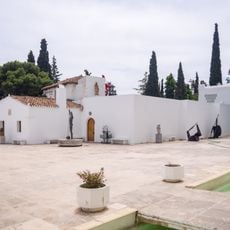
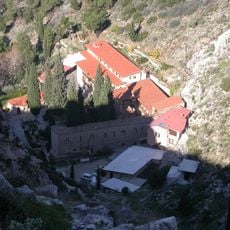
Kaisariani Monastery sits at 350 meters altitude on the northern slopes of Mount Hymettus and brings together traditional stone buildings within protective walls forming a fortified complex. The site includes a main church, refectory, bathhouse, and monk cells accessible through two separate entrances.
The surviving katholikon was built around 1100, on a site used as a cult centre since Antiquity, when it was probably dedicated to Aphrodite; Christians took it over in the 5th/6th century. After the Fourth Crusade, Pope Innocent III mentioned the monastery, which stayed in Orthodox hands. In 1458, according to Jacob Spon, Sultan Mehmed II received the key to the city here.
The katholikon's frescoes were funded by the wealthy Benizelos family and painted in 1682 by Ioannis Ypatos of the Peloponnese, as an inscription on the western wall records. The dome shows Christ Pantokrator; the rosette depicts the Preparation of the Throne, the Virgin, John the Forerunner and angels. On the southern exterior wall, an older Theotokos in prayer, painted with sweeping strokes, points to 14th-century rural work.
The monastery stands on the western slope of Mount Hymettus, reached by paths from the Kaisariani district of Athens. A high wall encloses the katholikon, refectory, bathhouse and cells, and the original design had two entrances: the main one on the eastern side and a larger one opposite. The buildings are grouped around a courtyard, with the katholikon to the east and the refectory and kitchen to the west.
The bathhouse features a semi-spherical dome without vaulting, an uncommon construction technique for its period. During Ottoman occupation the building was repurposed as an olive oil press, showing how the monastery adapted to changing times.
The community of curious travelers
AroundUs brings together thousands of curated places, local tips, and hidden gems, enriched daily by 93,111 contributors worldwide.