Melissani Cave, Underground lake cave in Karavomylos, Greece
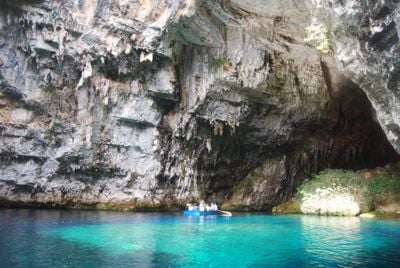
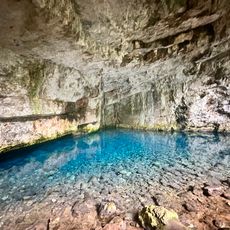
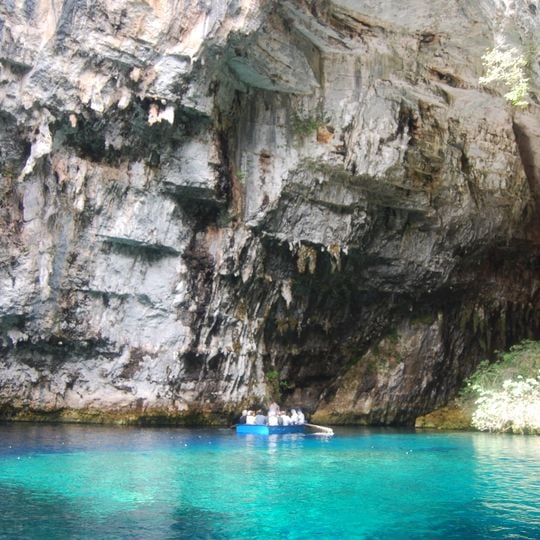
The site holds an underground lake roughly 130 feet (40 meters) wide and 118 feet (36 meters) long, filled with turquoise water. A large circular opening in the limestone ceiling admits natural light that sparkles on the water surface and illuminates the damp rock walls.
The cave was rediscovered in 1951, when Giannis Petrocheilos found a Hellenistic lamp on the islet inside the lake. Excavations by Spyridon Marinatos in 1963, during work on the artificial tunnel, yielded three relief plaques, a relief disc showing Pan playing the syrinx surrounded by dancing nymphs, a Pan figurine, three lamps and pottery. The finds indicate cult use of Pan and the Nymphs in the 4th and 3rd centuries BC.
Three explanations exist for the name Melissani: the nymph Melissanthe, who in one myth killed herself in the lake after Pan rejected her; a shepherdess of the same name who fell in while searching for a lost sheep; and Homer's land of the Melissae. The cave was also called the Cave of the Nymphs, and Pan and the Nymphs were worshipped here in the 4th and 3rd centuries BC.
Visitors board small rowboats steered by guides across the water to view the entire cave. Lighting is best between May and September when the sun shines nearly straight down through the ceiling opening around midday.
The lake's water is brackish, with a fresh-to-salt ratio of about 5:1. A 1963 dye test by Viktor Maurin and Josef Zötl showed that part of it enters the earth at the katavothres sinkholes near Argostoli and emerges here, while the rest comes from Mount Ainos and Agia Dynati.
The community of curious travelers
AroundUs brings together thousands of curated places, local tips, and hidden gems, enriched daily by 93,111 contributors worldwide.