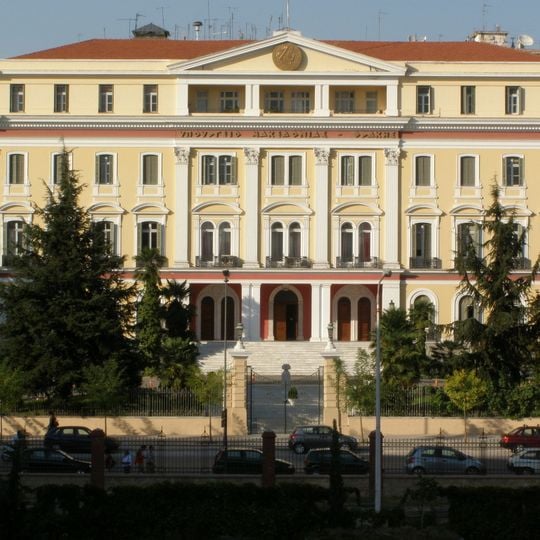
Government House, Protected administrative building on Agios Dimitrios Street, Thessaloniki, Greece.
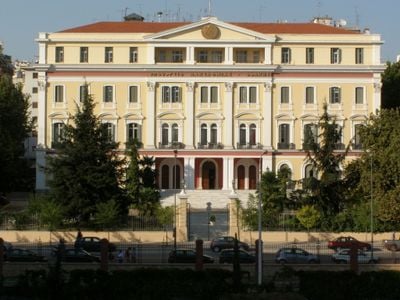
The Konak is a long, symmetrical building on Agios Dimitrios Street in central Thessaloniki, built in 1891 by Italian architect Vitaliano Poselli in an eclectic style with neoclassical elements. Its pale yellow facade has three main storeys plus a basement, topped by a low-pitched red tiled roof. A band of raised Greek lettering runs across the upper facade, below which six pairs of columns frame tall windows, each pair capped by a triangular pediment. The two outer pairs sit above round-arched windows, and the central entrance is a recessed round arch flanked by two smaller round-arched doorways, approached by a broad flight of steps. A fourth floor was added in 1955.
The building was constructed in 1891 as a residence for the Ottoman governor of the Salonica Vilayet and played a role during the Balkan Wars. It survived the major fire of 1917 that destroyed much of the surrounding city.
The name Konak comes from the Turkish word for a governor's residence, and Greeks also call the building Διοικητήριο, "administrative seat". A band of raised Greek lettering runs across the upper facade, above six pairs of columns with triangular pediments. The street behind it, Odos Proxenon, recalls the consuls killed in the 1876 Salonika incident.
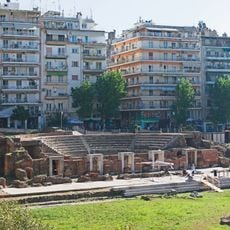
The main entrance is on Agios Dimitrios Street, and the building is also bounded by Filimonos, Dragoumi, Kassandrou and Proxenon streets. The surrounding streets are named for the consuls killed in the 1876 consular massacre. Opposite stands Diikitiriou Square, where excavations begun in 1990 uncovered antiquities and halted work on an underground car park.
The building was one of the few structures that remained unharmed during the devastating city fire of 1917. This fact makes it a rare survivor from that critical period in Thessaloniki's history.
The community of curious travelers
AroundUs brings together thousands of curated places, local tips, and hidden gems, enriched daily by 92,926 contributors worldwide.