Great Lavra, Orthodox monastery at Mount Athos, Greece
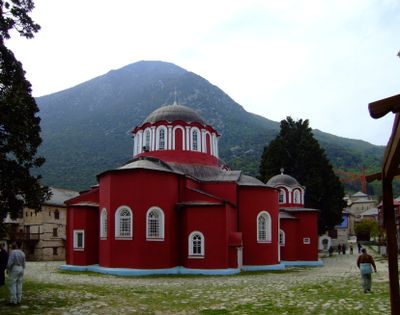
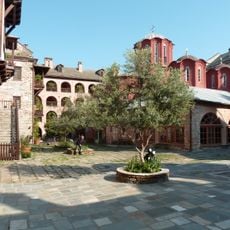
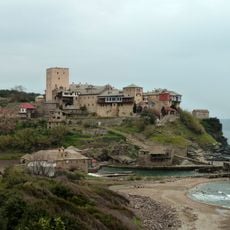
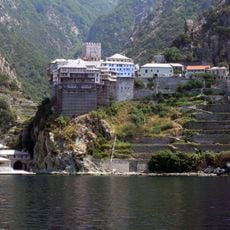
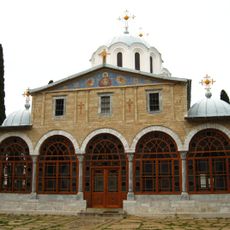
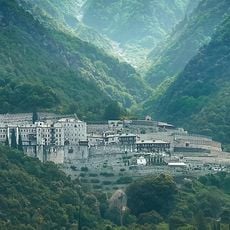
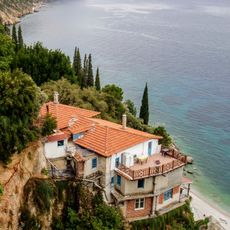
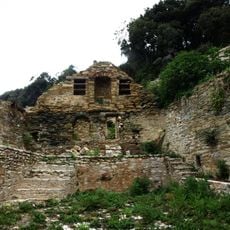
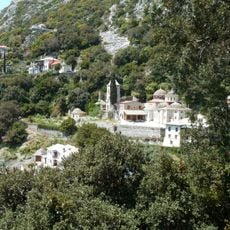
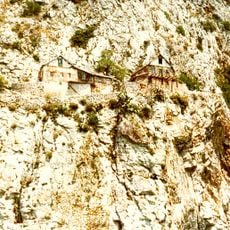
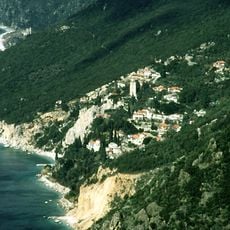
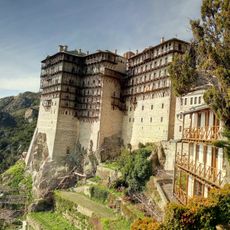
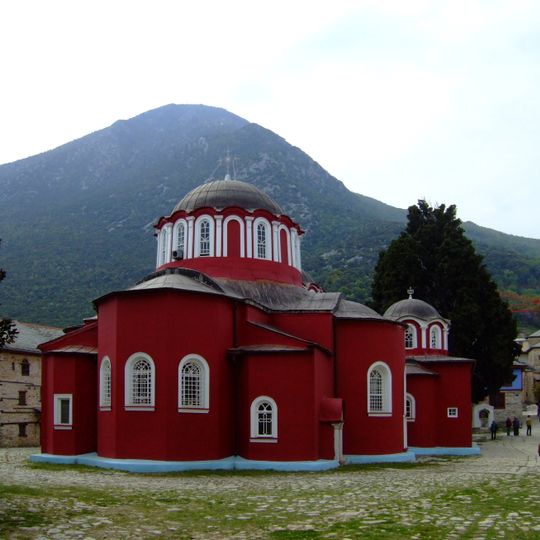
Great Lavra is a Byzantine monastery on Mount Athos featuring a main church, multiple chapels, residential buildings, gardens, and fortified walls. The complex spans across the mountainous terrain as one of the largest monastic establishments in this remote region.
Founded in 963 by Athanasius the Athonite on the site of the ancient city of Akrothooi, the monastery was financed by Emperor Nikephoros II Phokas and later supported by John I Tzimiskes, who doubled the imperial grant. Sacked during the Fourth Crusade in 1205, it endured pirate raids and earthquakes, and in 1575 Patriarch Jeremiah III restored the cenobitic rule. It returned to communal life in 1980.
The monastery's name comes from the Greek lavra, a type of monastery with a looser communal life; old documents also call it "Lavra of the Blacks" and "Lavra of kyr Athanasios". Its feast is 5 July, the day of Saint Athanasius. In the refectory, frescoes show ancient Greek philosophers such as Plato, Socrates, Pythagoras and Aristotle alongside the saints.
Access is restricted to male visitors who must obtain prior authorization from Mount Athos authorities. The remote location requires careful planning and arrangements before arrival.
The library holds about 2,116 manuscripts, 20,000 printed books and 100 manuscripts in foreign languages, plus eight maps from the 6th-century Coislin Codex. Among its documents is a charter of February 1016 signed by the heads of Athonite monasteries, including the abbot of the Rossikon, from the start of Yaroslav the Wise's reign.
The community of curious travelers
AroundUs brings together thousands of curated places, local tips, and hidden gems, enriched daily by 94,660 contributors worldwide.