Basilica of Saint-Romain, Religious monument in Blaye, France
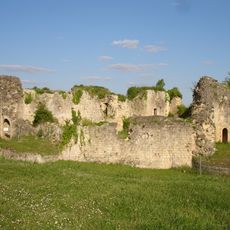
The Basilica of Saint-Romain is a ruined stone structure in Blaye, built of pale cream-colored rectangular blocks. Thick vertical piers separated by deep gaps survive, with a jagged broken lower edge at the left exposing rubble and darker stone. Larger flat-faced sections sit above rougher masonry near the base; trees and sky appear behind.
Built in the second half of the 4th century to house the tomb of Saint Romain, the basilica became the necropolis of Aquitaine's Merovingian kings, including Charibert II and his son Chilperic, killed in 632. In 788 it received the tomb of Roland, lord of Blaye, and in the 9th century the relics of Saint Sichaire. Damaged in the Wars of Religion, it was destroyed in the late 17th century to make way for the citadel's glacis; excavations from 1969 uncovered its foundations.
Pilgrims bound for Santiago de Compostela paused here before crossing the Gironde to Bordeaux. The 12th-century Chanson de Roland places the burial of Roland, Olivier and Turpin at Saint-Romain, and in Bordeaux pilgrims could see Roland's split ivory horn, the olifant. The name honours Saint Romanus, a 4th-century ascetic from North Africa who evangelised the Blayais.
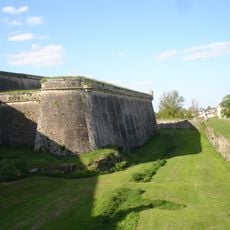
The basilica is a ruin: only foundations and lower masonry survive inside the Vauban fortress of Blaye, so there is no interior to enter. Look for the cream-coloured rectangular blocks and the deep gaps between the piers, with rubble at the broken left edge. Sixth- to eleventh-century capitals found in the 1969 excavations are kept in the town's archaeological museum.
King Francis I ordered Roland's tomb opened in 1526, confirming the basilica's link to this medieval military leader. This royal interest connected the sanctuary to the famous Song of Roland and pilgrimage traditions along the Road to Santiago.
The community of curious travelers
AroundUs brings together thousands of curated places, local tips, and hidden gems, enriched daily by 94,049 contributors worldwide.