Haguenot hotel, 18th-century folly in Montpellier, France
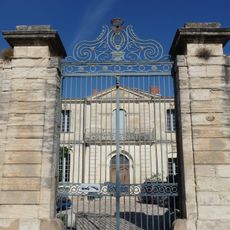
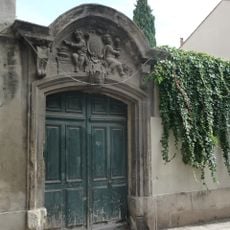
The Haguenot hotel is a Montpellier folly built between 1752 and 1760 by architect Jean Antoine Giral for the anatomist Henri Haguenot, on land below the newly laid-out promenade du Peyrou. Its entrance is a black wrought-iron gate between two pale grey stone pillars carved with leaf bands and raised bumps and topped by stone urns; the gate carries scrollwork and an openwork crest with a small oval shield. The garden, gate and monumental fountain have been classified as historical monuments since 8 February 1963.
In the 13th century the land belonged to Étienne Arnaud, brother of the inquisitor Guillaume Arnaud, and was later occupied by Dominican nuns who built a church and convent there. The plot became a farm, then passed through owners until Henri Haguenot, a physician and dean of the University of Montpellier, had his country house built between 1752 and 1760 by the architect Jean Antoine Giral. It has been classified as a monument historique since 1963.
The name comes from Henri Haguenot, an anatomist and dean of the Montpellier faculty who had the house built from 1752 to 1760 by architect Jean Antoine Giral. It is a folie, a country house of the Montpellier elite, later surrounded by the growing city. The entrance gate between carved stone pillars bearing urns is part of the protected ensemble.
The house stands at 6 rue de la Merci and 3 rue Clapiès, below the Peyrou promenade in central Montpellier. It is a private residence still occupied by the family that bought it in 1861, and visits are by appointment throughout the year. From the street, look for the wrought-iron gate between two carved stone pillars topped with urns.
The entrance gate on rue de la Merci is part of the 1963 listing, together with the garden and the monumental fountain. Its stone pillars carry carved leaf bands and urns, and the ironwork bears a small oval shield at the top. The orangery and service wings were listed separately in 1984.
The community of curious travelers
AroundUs brings together thousands of curated places, local tips, and hidden gems, enriched daily by 93,698 contributors worldwide.