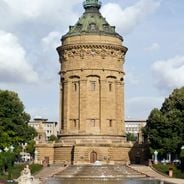
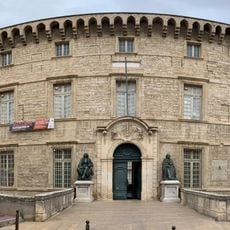
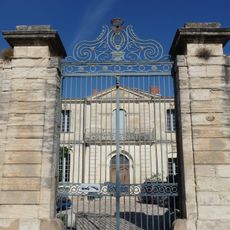
Water tower of Peyrou, Historic water tower in the promenade of Peyrou, Montpellier, France.
The water tower of Peyrou is a hexagonal stone pavilion on the Promenade du Peyrou, the highest point of Montpellier. Its six sides carry Corinthian columns, and it stands on a raised base reached by a wide flight of shallow steps, with a colonnade of four fluted columns and a triangular pediment facing the approach. It held the drinking water arriving from the Saint-Clément spring.
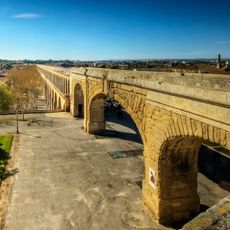
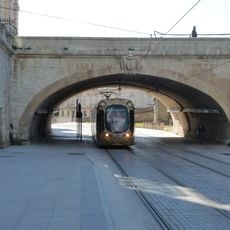
In the 18th century the province of Languedoc had engineer Henri Pitot divert water from the Saint-Clément spring to Montpellier, building the aqueduct from 1753 to 1766. The last stretch up to the Peyrou, where the aqueduct reaches about 22 metres in two stacked galleries, was rebuilt by engineer Giral between 1767 and 1775 as three large arches. The tower, reservoir and aqueduct were listed as monuments historiques in 1954.
Classified as a historical monument in nineteen fifty-four, this building represents eighteenth-century hydraulic engineering and reflects the importance placed on urban infrastructure development during the reign of King Louis the fifteenth.
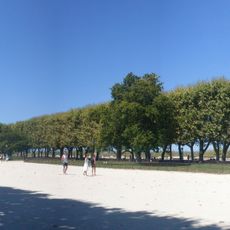
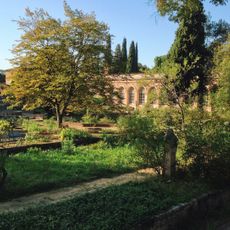
The water tower is located on the promenade of Peyrou, a public space covering approximately seven and a half acres in central Montpellier, and is easily accessible to visitors interested in historical architecture.
The aqueduct's final 880-metre stretch to the Peyrou, with two stacked galleries averaging 22 metres high, was rebuilt by engineer Giral between 1767 and 1775 as three large arches, stylistically different from Pitot's earlier work.
The community of curious travelers
AroundUs brings together thousands of curated places, local tips, and hidden gems, enriched daily by 94,049 contributors worldwide.