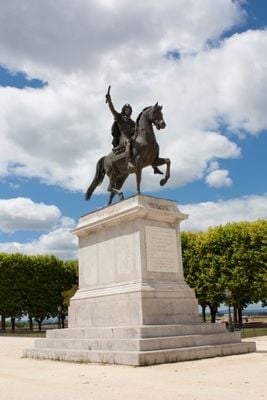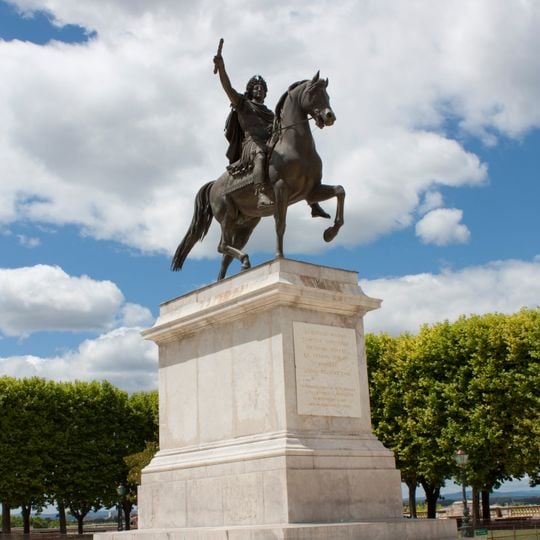
Equestrian statue of Louis XIV, Bronze sculpture at Promenade du Peyrou, France
The bronze equestrian statue of Louis XIV occupies the center of Peyrou Promenade, scaled to roughly twice the size of a real horse and rider. The figure sits atop a stone pedestal that forms the focal point of this grand baroque promenade.
The first bronze, cast in 1692 from designs by Jules Hardouin-Mansart, reached Montpellier by river in 1717 and was inaugurated on 27 February 1718. Toppled on 1 October 1792 and melted down for cannon, it was replaced by the present smaller replica, sculpted by Jean-Baptiste Joseph Debay and cast by Auguste-Jean-Marie Carbonneaux, erected in 1828.
The first statue, inaugurated in 1718, carried a Latin inscription by historian de Mandajors that Voltaire approved in Le Siècle de Louis XIV. Toppled on 1 October 1792 and sent to Lyon to be melted into cannon, it was briefly replaced by a guillotine that claimed about twenty victims. The replacement bears the motto 'EVERTERAT FUROR, RESTITUIT PIETAS'.
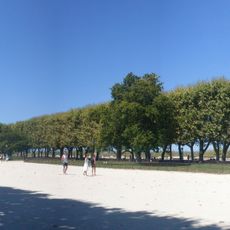
The statue stands at the centre of the Promenade du Peyrou, a flat, open esplanade reached on foot from the old town; the surrounding lawns and gravel paths are level and easy to cross. The bronze faces east, so morning light falls on the rider's raised arm and the horse's lifted foreleg.
In 1830, after the July Revolution, some proposed replacing the statue's head with that of Pierre-Paul Riquet, builder of the Canal du Midi, before the plan was dropped. The Latin motto 'EVERTERAT FUROR, RESTITUIT PIETAS' ('Fury destroyed it, Piety restored it') was adopted in 1814, when the Count of Artois laid the first stone.
The community of curious travelers
AroundUs brings together thousands of curated places, local tips, and hidden gems, enriched daily by 93,257 contributors worldwide.