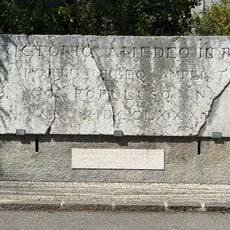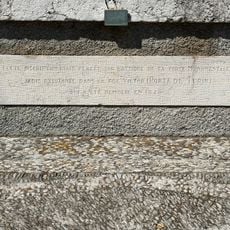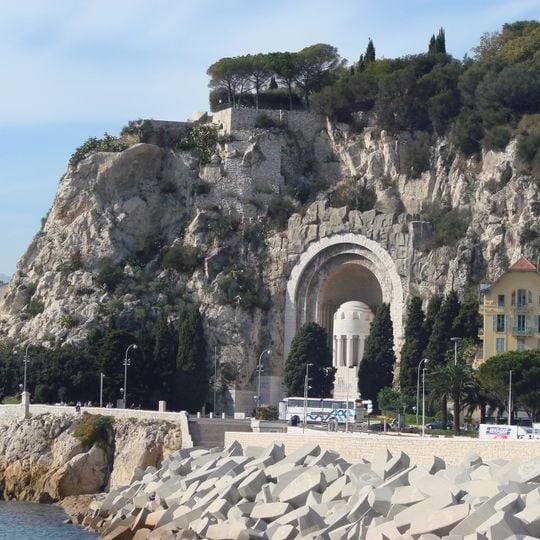
Monument aux morts de Rauba-Capeù, War memorial at Quai Rauba-Capeù, Nice, France.
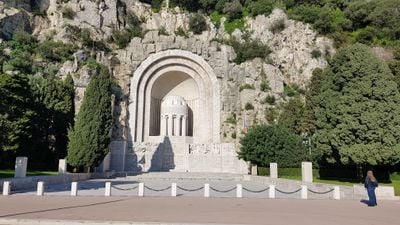
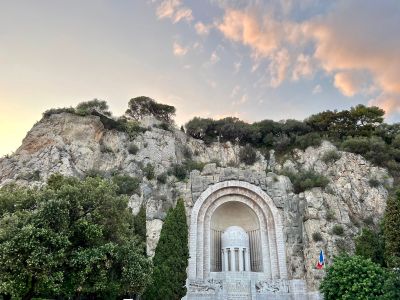
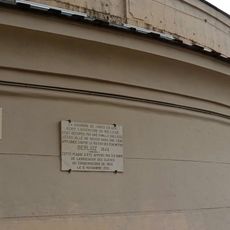
The Monument aux morts de Rauba-Capeù is cut into the pale cliff of the castle hill above the Route du bord de mer. A tall arched niche holds a cylindrical stone urn on a square base, bearing 3,665 nameplates of Niçois killed in the First World War. Stone masonry flanks the arch, and a two-metre sundial is inscribed in the base; with its surroundings the memorial reaches 32 metres.
Mayor François Goiran decided in 1919 to build a memorial to Nice's war dead. The project by Roger Séassal, winner of the 1913 Premier Grand Prix de Rome, was approved on 6 February 1923; the first stone was laid on 11 November 1924 and the work completed in 1927. Marshal Foch inaugurated it on 29 January 1928. It was listed as a monument historique in 2010 and classed in 2011.
The name Rauba-Capeù comes from the Niçois dialect for "hat-stealer", after the wind on this stretch of the Promenade des Anglais. The two high reliefs flanking the central inscription were carved by Alfred Janniot: war on the left, peace on the right. The central inscription reads: "The City of Nice to its sons, who died for France."
The memorial stands on the quay Rauba-Capeù along the Route du bord de mer, on the site of the old Ponchettes path linking the cours Saleya to the Lympia harbour. The esplanade is closed off by a chain barrier, and the monument is viewed from the pavement and the road edge. The cliff of the castle hill rises directly behind it.
In 2018, a metal eagle-shaped container holding memorial plaques was discovered inside the monument, located about 20 meters above ground. This hidden collection had remained unknown for decades, revealing how carefully names were preserved.
The community of curious travelers
AroundUs brings together thousands of curated places, local tips, and hidden gems, enriched daily by 93,669 contributors worldwide.