Lille observatory of astronomy, Astronomical observatory in Lille, France
Lille Observatory is a yellow-brown brick complex on impasse de l'Observatoire, built in 1932 by architect Marcel Boudin. A cylindrical brick tower carries a pale ribbed dome with a row of vertical windows beneath it; a flat-roofed brick wing with rectangular windows extends to the right, and a lower entrance section with a glass-paned door stands on the left. A second yellow-brick block with a flat grey roof and a tall chimney at its far corner is joined to the drum by a lower brick section with tall vertical windows, and a metal ladder runs up the dome's side.
Robert Jonckhèere, born in Roubaix in 1888, founded an observatory at Hem and inaugurated it in 1909, equipped with a 9-metre dome and a 35 cm refractor. After the First World War he sold his instruments to the University of Lille, and the Hem buildings were demolished in 1934. Lille's mayor Roger Salengro had a new observatory built in the Lille-Moulins district in 1932, designed by Marcel Boudin, to house the 35 cm refractor.
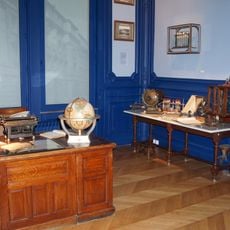
The observatory keeps a museum of instruments used in meteorology and astronomy: anemometers, barometers, sextants, a wire micrometer, receivers and numerous clocks. Robert Jonckhèere, who returned in 1940, worked here until 1962 and discovered 3,350 double stars. The 35 cm refractor from his earlier Hem observatory was transferred to this building.
The observatory is easily reached by public transit and sits near a major park in the city. Guided visits are offered on special occasions, so planning ahead to check opening times is worthwhile.
Inside the buildings is a museum displaying historical scientific instruments once used for meteorological and astronomical work. This collection shows the practical tools scientists relied on before modern electronic equipment became available.
The community of curious travelers
AroundUs brings together thousands of curated places, local tips, and hidden gems, enriched daily by 94,122 contributors worldwide.