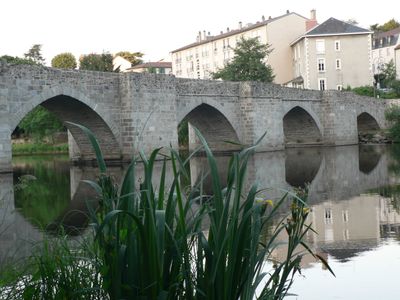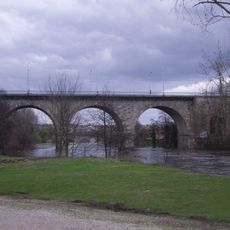
Saint-Étienne bridge, Medieval stone bridge in Limoges, France.
Saint-Étienne Bridge is a stone structure with multiple arches spanning about 120 meters across the Vienne River, connecting different districts of Limoges. The construction features characteristic rounded arches that support the passage while allowing water flow beneath.
Completed in 1203 below the Cité's wall, the bridge let cathedral-quarter residents cross the Vienne without depending on the Château and its old Pont Saint-Martial downstream. Two towers with drawbridges guarded its ends. Repaired in 1854, it was saved from demolition in 1903 after public protest, and was classified a monument historique in 1907.
The bridge marks the downstream limit of timber floating on the Vienne: logs from the Limousin forest were halted upstream by wooden "ramiers" built around 1760 and destroyed in 1897, then stored at the port au bois (port du Naveix). On the right bank stood the houses of the laveuses, who washed linen for the Château and later for Limoges households until the mid-20th century. Pilgrims on the Vézelay route to Santiago de Compostela still cross it.
The bridge is now reserved for pedestrians and is still used by pilgrims on the Vézelay route to Santiago de Compostela. It is about 5 m wide, or 11 m between the upstream cutwater and the downstream buttress, so crossing on foot is straightforward. Look for the last arch and the inscription recalling the 1619 works, buried under the Louis Goujaud quay.
The bridge marks the downstream limit of timber floating on the Vienne: logs from the Limousin forest were halted upstream by wooden "ramiers" built around 1760 and destroyed in 1897, then stored at the port du Naveix. A 12-franc stamp showing the bridge and Limoges cathedral was issued on 26 March 1955.
The community of curious travelers
AroundUs brings together thousands of curated places, local tips, and hidden gems, enriched daily by 94,470 contributors worldwide.