Pont de Caronte, Railway and swing bridge in Martigues, France.
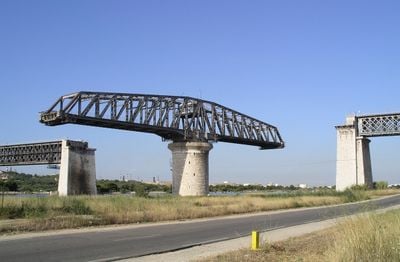
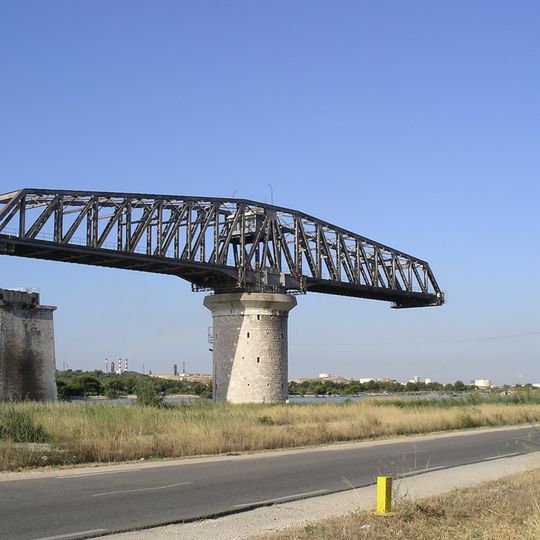
The Pont de Caronte is a nearly 1 km long railway and swing bridge that spans the Caronte bay and crosses the harbor. The structure has eight main spans and two central rotating sections that allow large vessels to pass through.
Construction began in 1908 under engineer Paul Séjourné and Schneider et Cie, and the line opened on 15 October 1915; at the time it was the world's largest and heaviest swing bridge of its type. In September 1944 retreating German troops blew it up, destroying the round central pier. Traffic returned in late 1946 over a temporary single-track Krupp lift span, and in 1954 Schneider et Cie rebuilt the swing span to the original plans, replacing the petrol motors with electric ones.
The bridge appears at the end of Jean Renoir's 1935 film Toni, set in Martigues, when Toni is shot at the bridge entrance. In Robert Guédiguian's 1991 Dieu vomit les tièdes, Cochise, Frisé and their friends meet inside the central pier of the swing span. The structure received the "Patrimoine du XXe siècle" label in 2000.
The swing span opens each afternoon for about an hour so that ships taller than 20 m can pass; the manoeuvre itself takes 5 minutes 7 seconds. The control cabin sits above the tracks at the pivot point, on the northern bank. The bridge carries the Miramas–L'Estaque line, so watch from the banks rather than the deck.
The rotating span is a single 114-metre truss block pivoting on a central pier, not two separate sections. It originally weighed 1,513 tonnes, 400 of them mechanisms, and turned on a bronze lens 83 cm across. Two 100 hp petrol engines drove it, replaced by electric motors in 1954.
The community of curious travelers
AroundUs brings together thousands of curated places, local tips, and hidden gems, enriched daily by 92,815 contributors worldwide.