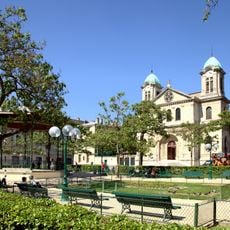
Saint-Jacques Saint-Christophe de la Villette, Neoclassical church in the 19th arrondissement, Paris, France.
Saint-Jacques-Saint-Christophe de la Villette is a Neoclassical church modelled on early Christian basilicas, built 1841–1844 by architect Paul-Eugène Lequeux. Inside, two rows of fluted Doric columns on square bases separate the nave from the side aisles and carry a row of high windows; the central vessel is covered by a painted coffered wooden ceiling. At the far end, the rounded apse holds three arched windows above a white marble altar with a gold cross, and a second small marble altar stands in the centre aisle. Rows of wooden chairs with woven seats fill the nave on light grey stone paving with dark tiled borders.
A 14th-century church already stood on the Roman road to Santiago de Compostela before the present building. Population growth after the Ourcq Canal opened led to a royal ordinance of 17 November 1837 authorizing land purchase, and architect Paul-Eugène Lequeux built the new church from 1841 to 1844. The choir was enlarged in 1930–1933, and the eastern tower was replaced by two copper-domed towers in 1930.
The name honors two patron saints: James for pilgrims heading to Santiago and Christopher for travelers. Inside, stained glass windows depict saints and biblical scenes that have shaped how worshippers experience the sacred space.
The church sits near Crimée metro station on line 7 and Laumière station on line 5, making it easy to reach. Visitors should plan for natural light to properly see interior details and check opening hours before visiting.
Inside sits an 1860 organ that gained a third keyboard in 2002 after its note transmission was electrified. This upgrade shows how historic instruments have been adapted with modern technology.
The community of curious travelers
AroundUs brings together thousands of curated places, local tips, and hidden gems, enriched daily by 93,524 contributors worldwide.