Butte de Montmélian, Ancient hilltop settlement remains in Mortefontaine and Saint-Witz, France.
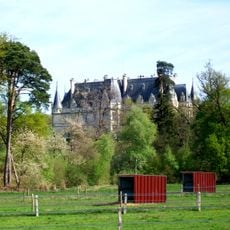
The Butte de Montmélian is a 203-metre hill topped by the ruins of the square tower of a 1205 manor, the only remnant of the old village of Montmélian. The surviving stone structure has three arched openings on its front face and a jagged, partly collapsed right side.
The old village of Montmélian stood on what is now the Mortefontaine enclave, with a royal castle from 1060, a manor from 1205 and a 13th-century pilgrimage church. Only the manor ruins survive, known locally as the Tour carrée de Montmélian. The site's archives, kept at Mortefontaine, burned on 17 November 1793 when revolutionaries set fire to the estate, so its history is only partly known.
The name Montmélian derives from the Latin Mons Medius, "middle mount", or from the Roman personal name Melianus; old forms include Mons Melianus (1205) and Montmiliant (1363). The hill marked the boundary between the Gaulish Silvanectes to the north and the Parisii to the south. From about 600 BC the Gauls are said to have worshipped Teutatès here in the forest by moonlight, cutting mistletoe with a golden sickle on the first night of the year.
The hilltop is easy to spot from the surroundings and offers wide views across the landscape from above. Visitors should wear sturdy footwear and expect exposed stones and uneven ground when exploring the site.
The hill's archives, kept at Mortefontaine, burned on 17 November 1793 when revolutionaries set fire to the estate, so its history is only partly known. The name appears as Mons Medius in the 2nd century and Mons Melianus in 1205, hesitating between "middle mount" and a Roman personal name Melianus.
The community of curious travelers
AroundUs brings together thousands of curated places, local tips, and hidden gems, enriched daily by 94,155 contributors worldwide.