Habitation Leyritz, Colonial estate in Basse-Pointe, Martinique, France
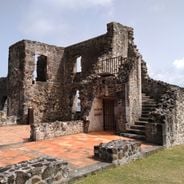
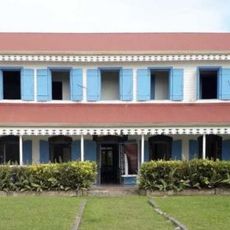
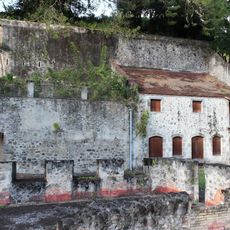
Habitation Leyritz is a former colonial plantation in Basse-Pointe, Martinique, whose buildings were listed as Monuments historiques in 2014. Two tall weathered stone pillars capped with small urns flank a broad, moss-edged stone stairway rising from the grass, with a pale stone plaque set into the left pillar. Trees and low shrubs surround the steps.
Michel Leiritz, born in Bordeaux in 1681 and a royal secretary, settled at Basse-Pointe in 1712 by marrying Rose Asselain, widow of a planter who owned 20 hectares of indigo and about thirty slaves; this holding probably became the plantation. In 1791 it covered 497 hectares with 336 slaves, and 517 hectares in 1836. In 1845 its 250 slaves refused night work, and after 1848 the estate turned to rum.
The name Leyritz comes from the Limousin family that owned the plantation for over two centuries, from Michel Leiritz (1681-1764) onward. In December 1845, with 250 enslaved workers on the estate, the workshop refused night work; gendarmes backed by about a hundred troops from Fort Royal arrested the leaders, four of whom received 29 lashes each before being jailed in Basse-Pointe.
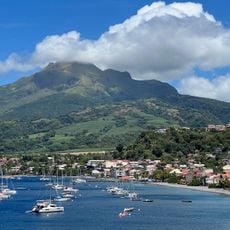
The site lies in Basse-Pointe on Martinique's northeast Atlantic coast, reached by the road along the coast from Le Lorrain or Macouba. The protected elements were inscribed as monuments historiques in 2014, and the property was selected in 2021 by the mission identifying endangered built heritage. Visits depend on the owners' opening; ask locally in Basse-Pointe before travelling.
The two weathered stone pillars with urn-topped caps and mossy steps are among the elements inscribed as Monuments historiques in 2014, alongside other buildings of the plantation. The 1788 hurricane had already destroyed the slave quarters and bagasse sheds, and toppled part of the savanna enclosure wall.
The community of curious travelers
AroundUs brings together thousands of curated places, local tips, and hidden gems, enriched daily by 92,927 contributors worldwide.