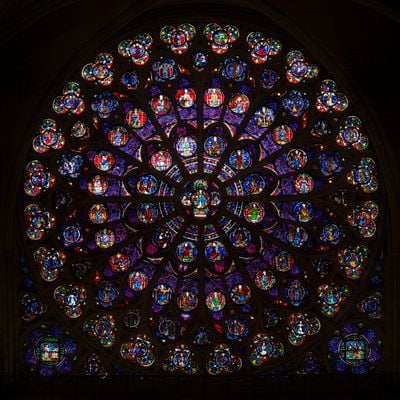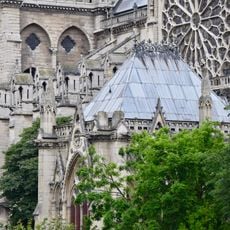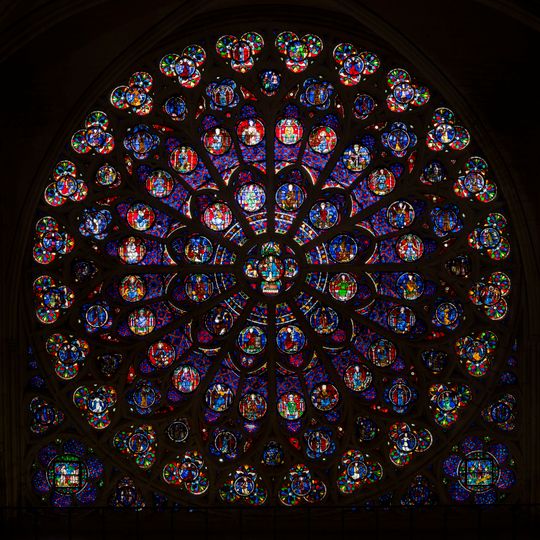
South rose window of Notre-Dame de Paris, Medieval stained glass window in Notre-Dame Cathedral, Paris, France
The South rose window of Notre-Dame de Paris is a circular stained-glass window set in a pointed stone arch, about 13 metres across. Deep blue and red glass dominates, with green, yellow and white accents. A small quatrefoil medallion at the centre is ringed by twelve round panes, and twelve tall petal-shaped panels each hold a standing figure under a canopy; a border of trefoil clusters runs around the edge.
The south rose was set into the south transept arm of Notre-Dame in the 1250s, during the Rayonnant rebuilding campaign; Pierre de Montreuil is associated with the work. It was funded by King Louis IX, who gave the glass. The window was restored in the 18th and 19th centuries, and the 2019 fire damaged it.
The window's programme is Marian: the Virgin and Child sit at the centre, ringed by twelve small round panes, while twelve tall petal panels each hold one standing figure under a canopy. A border of trefoil clusters, each with a figure, runs around the whole circle. The glass is mostly deep blue and red, with green, yellow and white areas.
The window sits high on the south arm of the transept, so it is seen from the floor of the crossing rather than up close. Morning light falls on the opposite north side; the south glass is lit later in the day. Binoculars help pick out the small round panes around the central medallion.
The outer ring is not a plain border: it is a chain of trefoil clusters, each holding a single figure, repeated around the whole circumference. Look for the twelve small round panes that ring the central medallion, a detail easily missed from the nave floor.
The community of curious travelers
AroundUs brings together thousands of curated places, local tips, and hidden gems, enriched daily by 92,884 contributors worldwide.