Pont au Double, Cast iron bridge near Notre-Dame Cathedral, Paris, France.
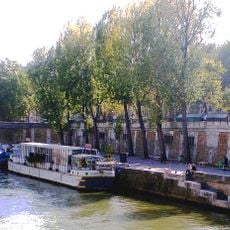
Pont au Double is a single-arch cast-iron bridge over the Seine, linking the parvis of Notre-Dame on Île de la Cité to the quai de Montebello in the 5th arrondissement. Its 31-metre arch is made of 11 cast-iron segments bolted together, with copper-clad faces and cornices. The bridge carries pedestrians and cyclists on a level deck.
A stone bridge with three arches was built here between 1626 and 1632 for the Hôtel-Dieu, whose wards were later placed above it; pedestrians paid a double denier toll, which gave the bridge its name. It collapsed on 31 December 1709 and was rebuilt, then demolished in 1847 for a single 31-metre masonry span. The present cast-iron arch, designed by engineer Jules Lax, dates from 1883 and was restored in 2002.
The bridge connects the student quarter with the cathedral district, serving as a natural gathering point where these two worlds meet daily. Locals and visitors cross here constantly, making it a working part of the city rather than just a landmark.
The bridge is simple to cross from either side, with easy access points for walkers and cyclists on both banks. The nearest metro stations are just a short walk away, making it convenient to reach from anywhere in the city.
The name comes from a medieval toll of two small coins that pedestrians once paid to cross here. This makes it unusual among Paris bridges, as most are named after different sources.
The community of curious travelers
AroundUs brings together thousands of curated places, local tips, and hidden gems, enriched daily by 93,412 contributors worldwide.