Robinier du Square Viviani, Black locust tree in Latin Quarter, France
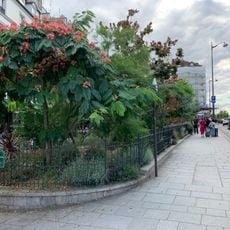
The Robinier du Square Viviani is a black locust (Robinia pseudoacacia) in the square René-Viviani, 5th arrondissement of Paris. Its trunk, over 3.5 m in circumference, leans under the weight of its crown and splits into two stems held by concrete supports; it reaches about 15 m. A circular chestnut-wood weave, built in 2010, rings the base and doubles as a bench.
Jean Robin, the royal gardener, planted this tree in 1601 using seeds brought from colonial territories in North America. This act launched one of the first successful introductions of American plant species to European gardens and city spaces.
The tree is commonly called "acacia" in French, though it is a black locust (Robinia pseudoacacia); Linnaeus named the genus after Jean Robin. Since 2010 a circular chestnut-wood coping woven in a medieval technique rings the trunk, doubling as a bench where visitors sit. Each spring, shoots sprout inside the enclosure and are removed every year.
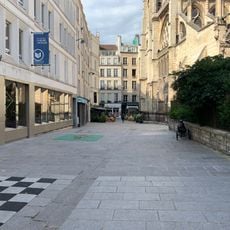
The tree is located on a public plaza that is open and accessible at all times for visitors. The protective structures around the trunk allow you to view the tree from different angles while maintaining safe distance from the aging wood.
The tree's seeds came from the Appalachian Mountains, sent to Jean Robin by the English naturalist John Tradescant the Elder. A cutting from this tree was planted by Robin's son Vespasien at the Jardin des Plantes in 1636, and that tree still stands today.
The community of curious travelers
AroundUs brings together thousands of curated places, local tips, and hidden gems, enriched daily by 94,483 contributors worldwide.