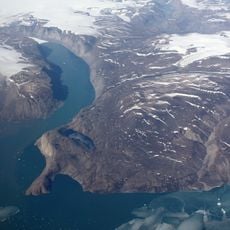
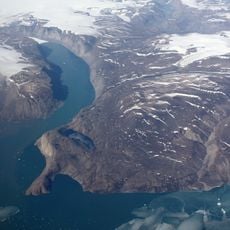
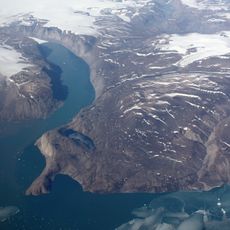
Nioghalvfjerdsbrae, Glacier in Northeast Greenland National Park, Greenland.
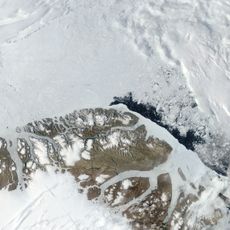
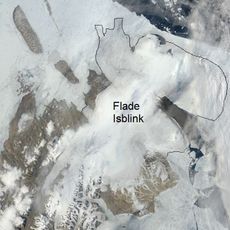
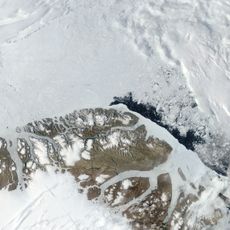
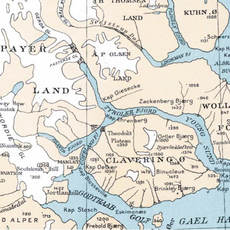
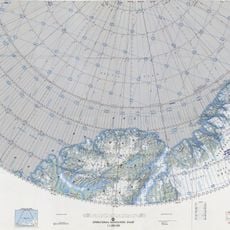
Nioghalvfjerdsbrae is a glacier in King Frederick VIII Land, northeastern Greenland, draining 103,314 km² of the Greenland Ice Sheet. It ends in Nioghalvfjerd Fjord with two calving fronts separated by Hovgaard Island, and its floating tongue has measured 80 km long and 20 km wide, widening toward the terminus north of Lambert Land.
The glacier formed thousands of years ago as part of the continental ice sheet during the last ice age. Its ice preserves a detailed record of climate shifts over many centuries and shows how the Arctic environment has changed.
The name comes from the Denmark expedition of 1906–1908, which named the glacier for the 79th parallel; it was meant to be temporary but gained meaning as the place where expedition leader Ludvig Mylius-Erichsen and cartographer Niels Peter Høeg Hagen died, according to Jørgen Brønlund's diary. Since 1990 Greenland's longest persistent supraglacial stream has run across the ice, 73 km long in 2011 and 71 km in 2017, mostly 20 to 35 m wide.
The glacier ends in Nioghalvfjerd Fjord, south of Dijmphna Sound, and its floating tongue once measured 80 km long and 20 km wide, widening toward the terminus north of Lambert Land. Two calving fronts face the ocean, separated by Hovgaard Island, so a boat approach depends on which front is open. The 73 km supraglacial stream running since 1990 gives a visible line to follow across the ice surface.
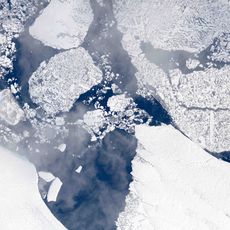
The glacier continuously releases massive icebergs that drift into surrounding waters, influencing the marine ecosystem and water circulation of the region. You can watch this calving process from the fjord, where breaking ice reveals deep cracks and fractured surfaces.
The community of curious travelers
AroundUs brings together thousands of curated places, local tips, and hidden gems, enriched daily by 93,849 contributors worldwide.