Crljivica, Medieval cemetery in Cista Provo, Croatia.
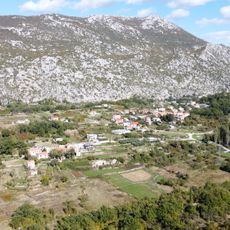
Crljivica is an archaeological zone of about 200 by 30 metres, split by the D60 road into Mala Crljivica to the south and Velika Crljivica to the north. It holds around 90 medieval tombstones called stećci: 16 gabled sarcophagi, 56 chests and 15 slabs, mostly of limestone. South of Velika Crljivica lie seven large karst wells.
Crljivica developed in three phases: three Bronze Age tumuli, the Roman road Salona–Tilurium–Novae–Narona, and a medieval cemetery of over 80 stećci. The stećci date from the 14th and 15th centuries, and inscriptions name Jerko and Vladna Kustražić. The road was converted into the modern D60 in the 20th century.
The tombstones carry crosses, anthropomorphic lilies, hunting, dancing and duel scenes, plant motifs, crescents and stars. Two partly preserved inscriptions in arvatica name Jerko and Vladna Kustražić; one stone is now in the Croatian Archaeological Museum in Split. The Kustražić family, of Vlach origin, is mentioned in the inscriptions and written documents.
The site has prepared pathways that guide visitors to the tombstones across the landscape. Sturdy footwear is recommended since the ground is uneven and the paths wind through natural terrain.
South of Velika Crljivica, in a sinkhole, stand seven large karst wells that supplied drinking water and livestock until the second half of the 20th century. Villagers cleared and walled them in 1990, setting a wooden cross on the western mound; several stećci were built into the well walls, one block bearing two rosettes and another the date 28 M 1779.
The community of curious travelers
AroundUs brings together thousands of curated places, local tips, and hidden gems, enriched daily by 94,431 contributors worldwide.