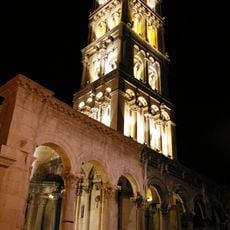
Silver Gate, Ancient gate in Split, Croatia
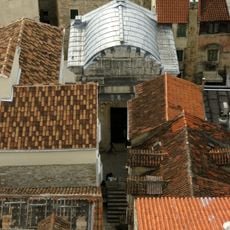
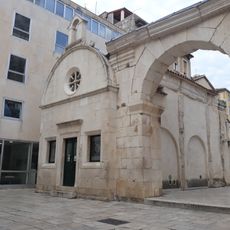
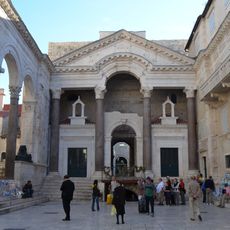
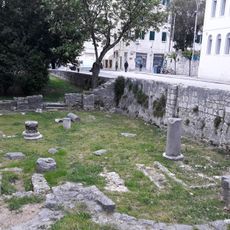
The Silver Gate, or Porta Orientalis, is the secondary eastern gate of Diocletian's Palace, set in the middle of the east wall between two octagonal towers, with four further towers beside them guarding the eastern approach. It was a double gate with an outer and an inner part, of which only the inner one remains; two niches that probably held sculptures survive, and the decoration is plainer than that of the Golden Gate.
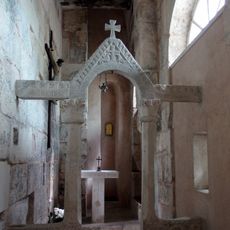
Built in the 4th century with Diocletian's Palace, the gate faced east toward Epetium, today's Stobreč. In late antiquity it was called Porta Orientalis. Probably in the 6th century a chapel to St Apollinaris was installed in the sentry corridor above it. The gate was walled up and absorbed into later buildings, including the Church of Dušica, and was only freed and reopened during restoration after the Allied bombing of World War II.
The gate faces east toward the Roman town of Epetia, today Stobreč. In the 6th century a chapel to St. Apollinaris was built in the sentry corridor above it, as refugees from Salona settled inside the palace walls. Opposite the gate, by the town market, stands the 13th-century Dominican monastery of St. Catherine of Alexandria.
The gate opens onto the eastern side of the old town, next to the main town market and opposite the 13th-century Dominican monastery of St. Catherine of Alexandria. From here the decumanus runs west through Pjaca to the Iron Gate. Only the inner gate survives; the outer gate was removed in the 1952 renovation.
The chapel of St. Apollinaris was built in the 6th century in the sentry corridor above the gate, one of four such chapels over the palace gates. The Baroque Church of Dušica, incorporated into the gate, was destroyed in World War II bombing; the gate was then renovated in 1952.
The community of curious travelers
AroundUs brings together thousands of curated places, local tips, and hidden gems, enriched daily by 94,667 contributors worldwide.