Budai Vigadó, Cultural center in Buda, Hungary.
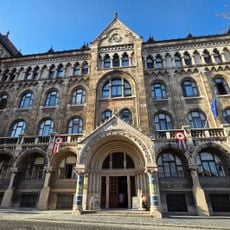
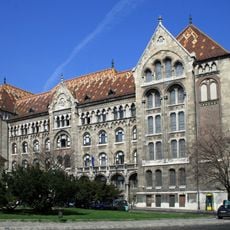
Budai Vigadó is a cultural center with eclectic architecture and a light-green interior lit by hundreds of lamps that highlight grand staircases and detailed stucco work. The building contains multiple performance spaces, a dance rehearsal room, and houses cultural institutions.
Buda's citizens petitioned deputy mayor Károly Gerlóczy for a hall like the Pesti Vigadó, and in 1894 the city gained the old military warehouse at Fő utca, Corvin tér and Iskola utca. A public competition drew 12 entries; the joint design of Mór Kallina and Aladár Árkay won. Built 1898–1900 from public donations, it opened on 20 January 1900 and was inaugurated with a carnival ball on 30 January.
The Budai Polgári Kör (Buda Citizens' Circle) rented rooms here continuously from 1900 until 1943, and the Budai Library Association's public library operated in the building until World War I. Since the 1950s the Hungarian State Folk Ensemble has been based here, performing 100–120 times a year. After the 2017–2018 reconstruction the building houses the Hagyományok Háza (House of Traditions), which opened with a four-day festival titled 'Határtalan Táncfőváros' (Boundless Dance Capital) featuring dance houses and craft workshops.
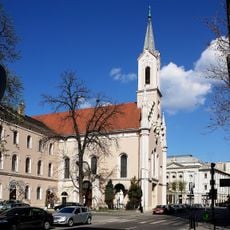
The building stands at the corner of Fő utca, Corvin tér and Iskola utca in the 1st district of Buda, on the right bank of the Danube. The main entrance opens onto a vestibule and a wide marble staircase with columns; the 306-seat theatre hall and the 350-square-metre ballroom lie beyond it.
Large murals by Erik Pauli titled 'The Eve' and 'The Morning' decorate the main hall, capturing moments of transition. Oversized mirrors on the walls create depth and were part of the original design scheme.
The community of curious travelers
AroundUs brings together thousands of curated places, local tips, and hidden gems, enriched daily by 93,458 contributors worldwide.