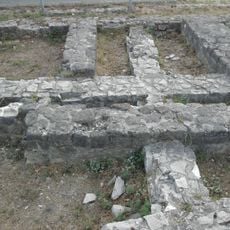
Aquincum civil amphitheatre, Roman amphitheatre ruins in Óbuda, Hungary.
The Aquincum civil amphitheatre is an earthen amphitheatre outside the northern wall of the Roman town, with an almost circular plan measuring 86.5 by 75.5 metres. Its seating was formed by earth rammed between two ring walls, topped with stone benches, some carved with owners' names. A 3-metre podium wall enclosed the arena, and two gates on the east-west axis gave access.
Built before the middle of the 2nd century AD, the civil amphitheatre stood outside the northern wall of Aquincum and was renovated several times in the 3rd century. Its excavation began in 1880 under Károly Torma, and the monument was later restored to plans by Gyula Hajnóczi and Ágnes Vladár.
Stone benches carried carved names of their owners, reflecting the social order of the Roman settlement at Aquincum. Visitors can still observe these inscriptions and understand how seating position indicated a person's standing in the community.
The site is straightforward to explore and sits within a residential neighborhood where you can walk among the ruins at your own pace. You can view the remains from multiple angles and understand the layout of the seating areas from ground level.
South of the western gate stood a shrine to Nemesis, goddess of the arena games. Excavating it brought to light a fragment of a small inscribed statue of the goddess and several inscribed altar stones. The shrine lay just outside the gate through which spectators entered the arena.
The community of curious travelers
AroundUs brings together thousands of curated places, local tips, and hidden gems, enriched daily by 92,618 contributors worldwide.