Aquincum Mithraeum, Roman temple ruins in Óbuda, Hungary.
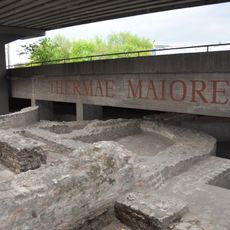
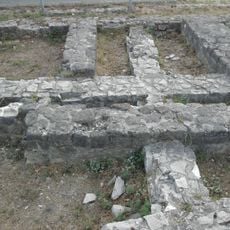
The Aquincum Mithraeum is a shrine built inside a townhouse near the centre of the Roman city of Aquincum, in today's Óbuda. The sanctuary measured 7 m wide by 15.03 m long and ran north to south, with a front room, a middle room probably used as a narthex, and a central nave about 2.18 m wide sunk 1 m below ground, flanked by podium benches reached by single steps. Two small altars dedicated by Marcus Antonius Victorinus stand in front of the benches.
The shrine was found in 1888 inside a large townhouse near the centre of Aquincum. Its size and location point to the decurion Marcus Antonius Victorinus, who dedicated several small altars there. The temple was oriented north to south and measured 7 m by 15.03 m.
The sanctuary's altars name Marcus Antonius Victorinus, a decurion and aedile of Aquincum, who dedicated them to Cautes, Cautopates and a lasting spring. A limestone relief shows Mithras emerging from the rock with a torch and dagger, a serpent coiled around the stone. The tauroctony fragment and an altar are displayed in the eastern wing of the Lapidarium.
The shrine stands fully accessible within the Aquincum Archaeological Park, just south of the Aquincum Museum building. The remains were heavily restored and consolidated for display. The tauroctony fragment and the altar are kept in the eastern wing of the Lapidarium at the northern edge of the park, while the Victorinus altars are the originals in situ.
The tauroctony fragment found in the excavations once stood on a large stone base at the south end wall of the cella; it and the altar are now displayed in the eastern wing of the Lapidarium at the northern edge of the Archaeological Park, while the altars of Marcus Antonius Victorinus remain in situ.
The community of curious travelers
AroundUs brings together thousands of curated places, local tips, and hidden gems, enriched daily by 92,619 contributors worldwide.