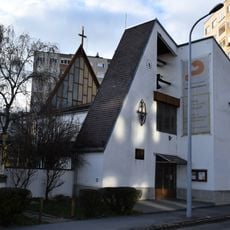
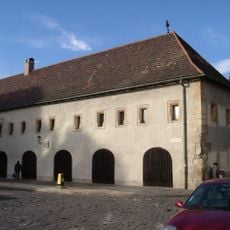
Villa Hercules, Roman villa museum in Óbuda, Budapest, Hungary
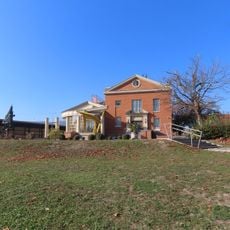
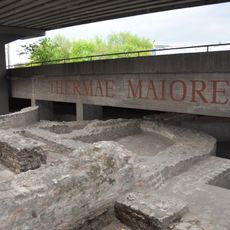
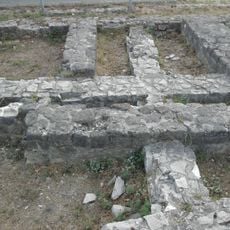
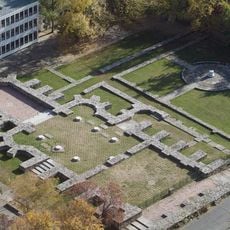
Villa Hercules is a Roman villa urbana at Meggyfa utca 19-21 in Budapest's 3rd district. Its core is a porticoed building with several rooms, including an apsidal one. Two glass-walled protective structures cover the remains: the larger over the central residential section, the smaller over the separate bath building. The villa's decorative hall is displayed in a ground-floor room of the adjacent school.
A small villa stood here in the first half of the 2nd century AD; it was rebuilt in the 2nd century and enlarged around 200 with a water supply and underfloor heating. Further work continued into the 4th century. The villa was probably destroyed around 270 during a Vandal attack. Excavations began in 1958 under István Wellner after the ruins were found during foundation work for a school.
The villa's name comes from a floor mosaic showing Hercules and Deianeira. Other mosaics depict a drunken Hercules, the winged Eros holding grapes, a walking tiger and boxers, framed by geometric patterns and plant ornament. Painted walls show flower-patterned door and window frames, coloured garlands and birds.
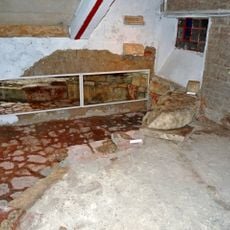
The site is protected by glass walls over two sections and can be viewed from the ground floor of the adjacent school building. Check accessibility before visiting since it is located within a school property and may have limited viewing hours.
The Hercules mosaic with Deianira lies in the central building under the larger of two glass-walled protective structures, not in the Aquincum Museum. The separate bath building has its own smaller shelter, and the villa's ornamental hall is displayed in a ground-floor room of the school built over the site.
The community of curious travelers
AroundUs brings together thousands of curated places, local tips, and hidden gems, enriched daily by 92,879 contributors worldwide.