Jankovich Cave, Prehistoric limestone cave in Bajót, Hungary
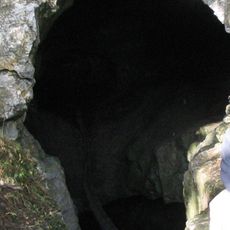
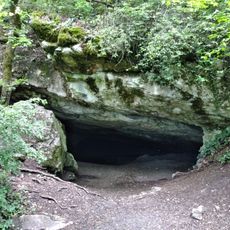
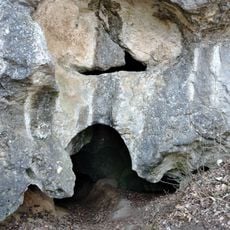
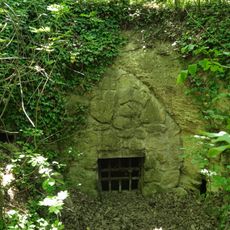
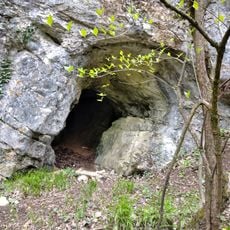
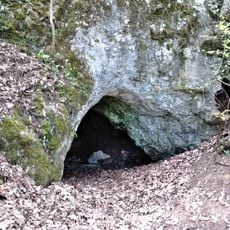
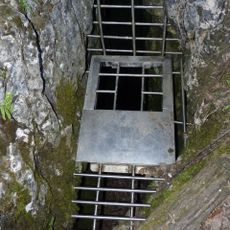
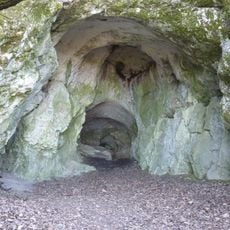
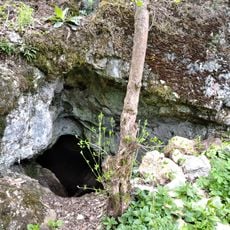
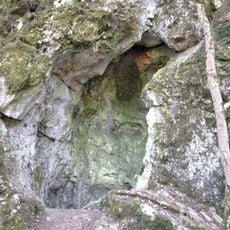
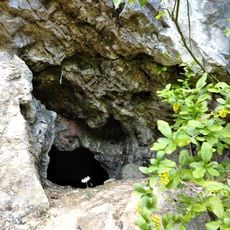
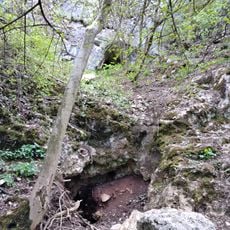
Jankovich Cave is a 36-metre-long karst cave near Bajót, opening with a north-facing portal about 10 metres high and 7 metres wide. Behind it lies the Great Hall, roughly 15 metres high, whose ceiling has a circular opening 6 metres across. The walls show slanted limestone beds and many scallops; the rear section drops by about half and narrows into a vaulted passage with a side branch to the Kuppel-Raum.
Excavations led by Jenő Hillebrand between 1913 and 1918, and again in 1925, removed much of the cave's up to 6 m thick sediment. The finds gave the name Jankovichien to a local Transdanubian variant of the Szeletien, with 104 pieces showing its typical traits. A 1956 campaign tried to reconstruct the original stratigraphy from remaining deposits.
The cave is named after Béla Jankovich, Hungary's minister of religion and education (1865–1939), who funded the first excavation campaigns. It also gave its name to the Jankovichien, a local Transdanubian variant of the Szeletien industry, defined by 104 characteristic lithic pieces from the side passage and Kuppel-Raum.
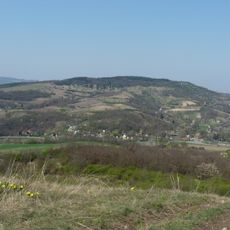
The cave is accessible year-round in the Gerecse Mountains without entrance fees. Marked hiking trails connect it to other destinations in the mountain region, making it a natural stopping point on longer walks.
The rear side passage and the domed Kuppel-Raum yielded most of the cave's Palaeolithic finds, including 104 pieces classed as Jankovichien. Among them are twelve bone points with solid or split bases, an ivory rod and an ivory amulet engraved with ornaments, kept today in the Hungarian National Museum in Budapest.
The community of curious travelers
AroundUs brings together thousands of curated places, local tips, and hidden gems, enriched daily by 93,160 contributors worldwide.