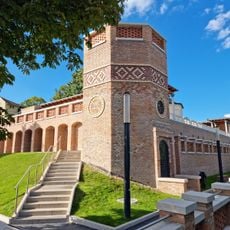
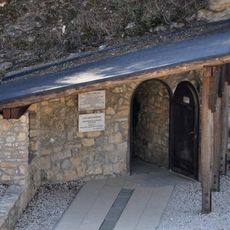
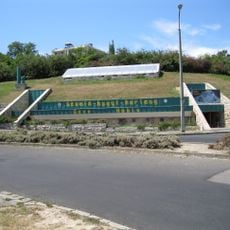
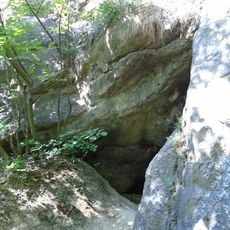
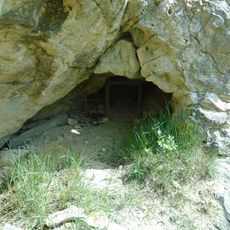
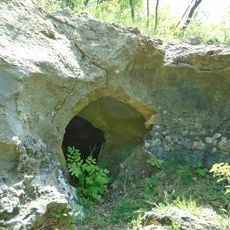
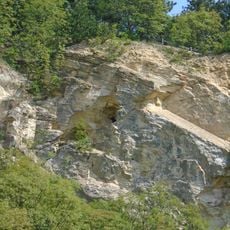
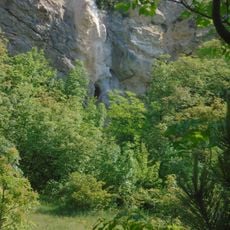
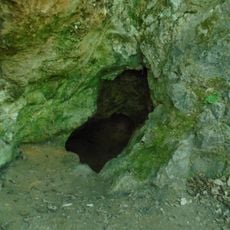
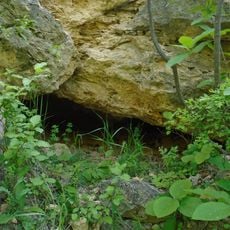
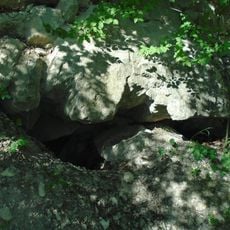
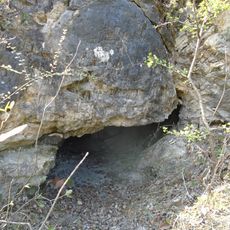
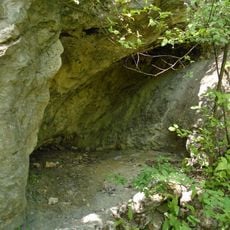
József-hegyi Cave, Natural cave system in Budapest, Hungary.
József-hegyi Cave lies beneath Szemlőhegy in Budapest's District II, entered via an artificial portal on Józsefhegyi Street. Its passages follow three levels: Triassic Mátyáshegy Limestone at the base, Eocene Szépvölgy Limestone in the middle, and bryozoan marl above. The Kinizsi-pályaudvar hall, 67 m long, 20–25 m wide and 5–12 m high, is the world's largest thermal-water cave chamber.
The passages formed in three rock layers: Triassic Mátyáshegy Limestone over 200 million years old, about 40-million-year-old Szépvölgy Limestone, and 36–38-million-year-old bryozoan marl. Thermal water widened tectonic fissures running east–west. The clay floor of the Kinizsi-pályaudvar hall cracked about 220,000–230,000 years ago; water rose again 210,000 years ago, and 200,000 years ago a warm spring broke through to the surface.
The József-hegyi Cave belongs to a network of caves that received UNESCO World Heritage recognition for their geological and scientific importance.
Access to the cave is only possible through organized guided tours where visitors navigate uneven ground and stairs. Wear sturdy footwear and follow your guide closely, as the underground environment is cool and humid throughout your visit.
The cave's average temperature exceeds 13 °C, nearly 2 °C warmer than other caves around Rózsadomb, which suggests a link with today's thermal springs and with the Molnár János Cave lying about 15 m deeper. In the Kinizsi-pályaudvar hall, gypsum still precipitates on the clay plates, giving them a glittering surface.
The community of curious travelers
AroundUs brings together thousands of curated places, local tips, and hidden gems, enriched daily by 92,993 contributors worldwide.