Museum of Applied Arts, Art Nouveau decorative arts museum in Budapest District IX, Hungary.
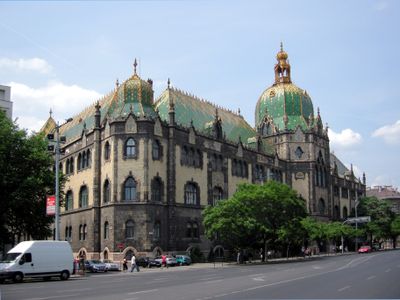
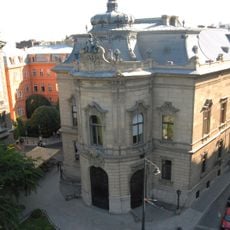
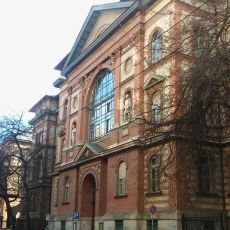
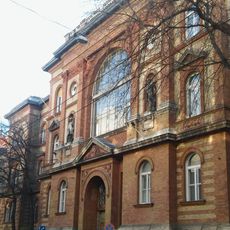
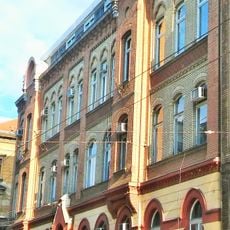
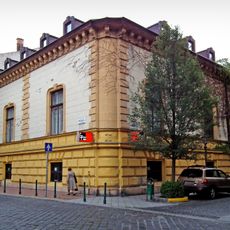
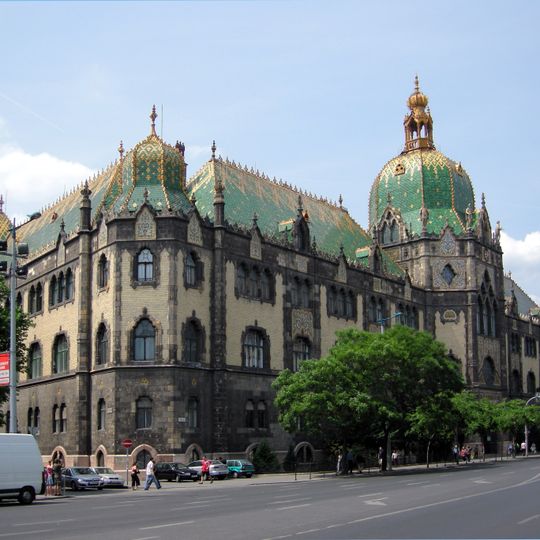
The Museum of Applied Arts stands at Üllői út 33–37 in Ferencváros, a pale yellow brick corner building on a grey stone base with arched openings. Ödön Lechner and Gyula Pártos designed it in the Hungarian Secession style: two window rows, the lower arched and the upper pointed in stone surrounds, under a steep roof of green tiles laid in a diamond pattern, with a pointed tower on the left and a taller green dome with a golden ornament on the right. The building has been closed for reconstruction since 4 September 2017.
The museum was founded by parliament in 1872, the third-oldest applied arts museum in the world, after London (1857) and Vienna (1864). Ödön Lechner and Gyula Pártos won the 1890 competition with a plan titled "Keletre magyar!" and built the palace in 1893–1896; Franz Joseph I attended its inauguration on 25 October 1896. The building has been closed since 4 September 2017 for reconstruction.
The museum keeps the only surviving noble treasury from medieval and early modern Hungary, that of the Esterházy family. Its Secessionist glass and ceramics and its Islamic-Turkish carpet collection are of world standard. The building has housed part of the School of Applied Arts since its founding, and the editorial office of the journal Magyar Iparművészet also works here.
The building on Üllői út has been closed to visitors since 4 September 2017 because of reconstruction work, so the collections cannot be viewed there. The museum's furniture collection is shown at the Száraz-Rudnyánszky Castle in Nagytétény, and since 1 July 2024 the institution has operated within the Hungarian National Museum Public Collections Centre. The main building stands near the southern end of the Grand Boulevard, reachable by metro line 3.
The architecture combines unexpected elements from Hindu, Mughal, and Islamic designs with Hungarian decorative motifs. This unusual fusion was a deliberate attempt to create a modern Hungarian art movement that reached beyond European boundaries.
The community of curious travelers
AroundUs brings together thousands of curated places, local tips, and hidden gems, enriched daily by 92,634 contributors worldwide.