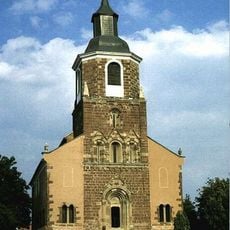
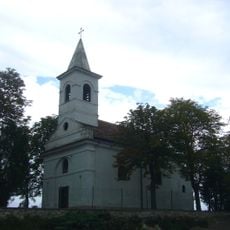
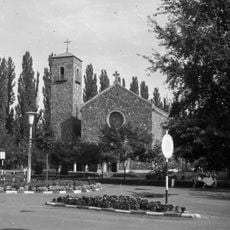
Round church in Balatonfüred, Catholic church building in Balatonfüred, Hungary.
The Round Church in Balatonfüred is a Roman Catholic chapel built in the Neoclassical style on a Greek-cross plan, modelled on the Roman Pantheon. Its dome carries a lantern topped by a cross set in 1844. Inside, the main altar painting shows Jesus and the Samaritan woman at Jacob's well, with a palm tree in the background.
Guests taking the "Savanyóvíz" mineral water asked for a chapel in the spa quarter from the 1850s, and construction of the Greek-cross building began in 1841 to plans by the Győr architect Antal Frumann, modelled on the Roman Pantheon. The cornerstone was laid on 21 September 1841; money ran out and the Tihany Benedictine Abbey borrowed from Count Róbert Zichy in 1845. The cross was set on the lantern on 4 December 1844 and Abbot Béla Bresztyenszky consecrated the church on 21 June 1846, with Ferenc Deák present.
The high altar painting shows Jesus and the Samaritan woman at Jacob's well, painted by the Austrian Henriette Kärling of the palatine's court; the model for the woman was Eleonóra Szentgyörgyi Horváth. The well scene alludes to the sour-water spring. The original was by Annibale Carracci, 17th century. The four evangelists on the dome were painted by Ferenc Pucher the elder of Veszprém.
The chapel stands in the old Fürdőtelep resort quarter, where the roads to the pier and the Szívkórház heart hospital meet. The building is a Greek-cross plan with a dome and lantern, so look up at the cross set on the lantern on 4 December 1844 by the estate carpenter Vencel Hayek. Near the entrance are two bronze reliefs commemorating refugees who found shelter in Balatonfüred from the 1919 communist terror; the "Mit féltek, kicsinyhitűek" relief was unveiled in 1928, removed at the end of the 1940s, kept at the parish and returned in the early 1990s.
The main altar painting shows Jesus and the Samaritan woman at Jacob's well; the model for the woman was Eleonóra Szentgyörgyi Horváth, per family records. The well scene alludes to the sour-water spring and its healing reputation. The original was painted by Annibale Carracci in the 17th century; the copy here is by the Austrian painter Henriette Kärling, who stayed at the palatine's court.
The community of curious travelers
AroundUs brings together thousands of curated places, local tips, and hidden gems, enriched daily by 94,253 contributors worldwide.