Round Church, Öskü, Catholic rotunda in Öskü, Hungary
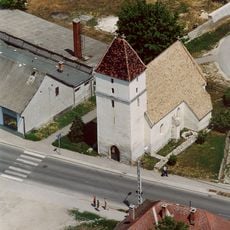
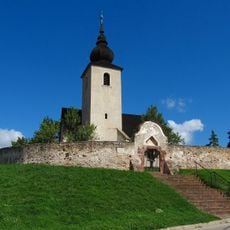
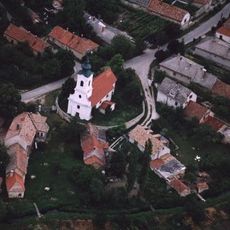
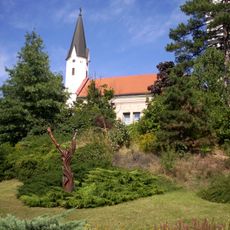
The Round Church crowns a rocky hill at the foot of the Bakony hills. Its nave is not circular but slightly oval, about 7 m across, and the present roof form dates from the early 18th century. Two Romanesque slit windows open on the south side and a small round window on the west; the chancel originally had a horseshoe-shaped inner arch.
The rotunda likely dates from the 11th century, as confirmed by the 1975/76 restoration. In the Middle Ages the village, then called Őskő, belonged to the Szalók clan and later to the Újlaki family, who built a castle nearby. After Székesfehérvár fell in 1543 the Turks destroyed the village. The Zichy family settled Slovaks from the 1710s, and the church was rebuilt as a Catholic church in 1725; a new roof was added in the early 18th century. When the larger parish church was built in 1843–1847, the rotunda became a chapel.
The village was originally called Őskő and belonged to the Szalók clan; in the mid-15th century it passed to the Újlaki family, who built a castle in the village. After 1725 the round church served as the Catholic parish church, but it became too small for the growing population, so the present parish church was built in 1843–1847. Since then the rotunda has been used only as a chapel.
The rotunda stands on a rocky hill at the foot of the Bakony hills, above the stream; the Újlaki castle once rose on the opposite height. Since 1843–1847 it has served only as a chapel, so it has no regular parish services. Look for the two Romanesque slit windows on the south side and the small round window to the west.
The nave is not truly circular: surveys during the 1975/76 restoration found an oval plan nearly 7 m across, and the chancel arch was originally horseshoe-shaped. The 15th-century iron key of the church was moved to the Veszprém museum in 1909.
The community of curious travelers
AroundUs brings together thousands of curated places, local tips, and hidden gems, enriched daily by 93,549 contributors worldwide.