Loughcrew, Neolithic passage tomb cemetery in County Meath, Ireland
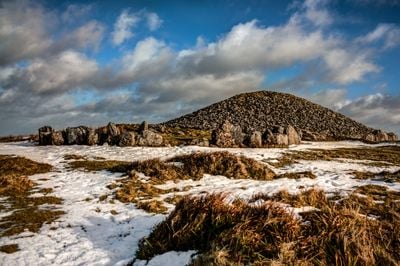
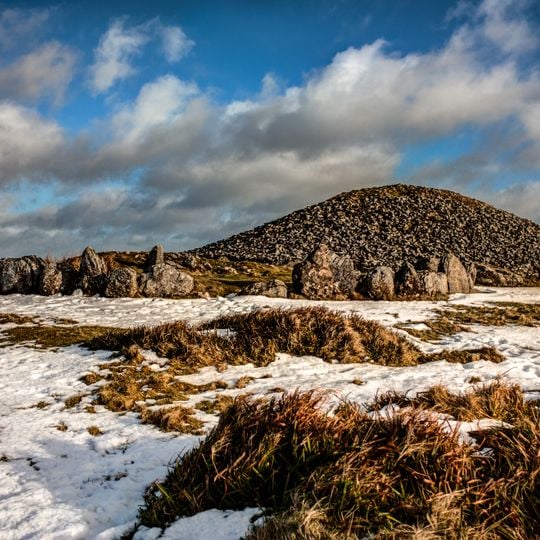
Loughcrew is a large cemetery with over twenty ancient tombs scattered across four hilltops: Carnbane East, Carnbane West, Carrickbrack, and Patrickstown Hill. The hills sit in open countryside with views across County Meath's landscape.
Loughcrew's more than thirty tombs were probably built between about 3500 and 3000 BC, in the Middle Neolithic; archaeologist Jean Mary McMann proposed this range after comparing their architecture and art with Newgrange and Knowth. The chambers are cruciform, with side chambers along a passage, and were covered by stone mounds. The structural stones are local green gritstone, soft enough to carve. Cairn H, excavated in 1943, yielded bone objects in Iron Age La Tène style.
The place name Slieve na Calliagh comes from Irish and means mountain of the Cailleach, a significant figure in Irish mythology. Locals connect this site to the legendary figure, and it remains part of regional storytelling.
The two gated cairns, Cairn L and Cairn T, can only be visited after arranging a key handover in advance. The other cairns stand unprotected on the hilltops and are reached on foot over uneven, exposed ground, so sturdy footwear is needed. Rain erosion has worn many carvings on the unprotected stones.
Cairn T's equinox alignment was identified in 1980 by Irish-American researcher Martin Brennan, who found that rising sun at the spring and autumn equinoxes shines down the passage onto the decorated backstone. He also noted alignments at Cairn L and at Knowth and Dowth in the Boyne Valley.
The community of curious travelers
AroundUs brings together thousands of curated places, local tips, and hidden gems, enriched daily by 94,175 contributors worldwide.