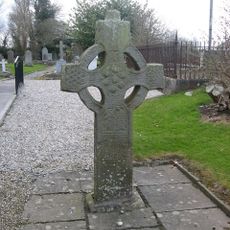
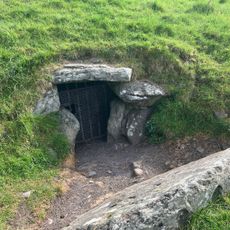
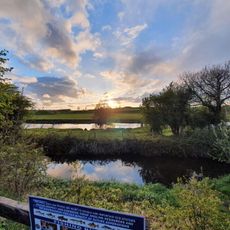
Brú na Bóinne, Prehistoric archaeological complex in County Meath, Ireland.
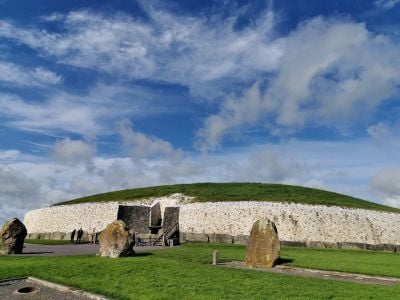
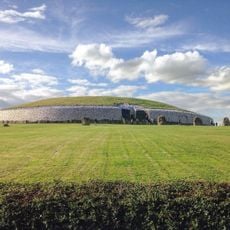
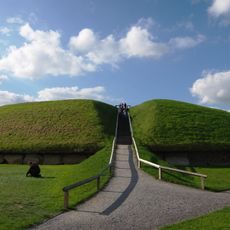
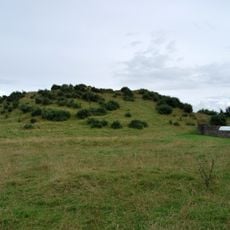
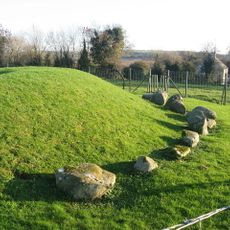
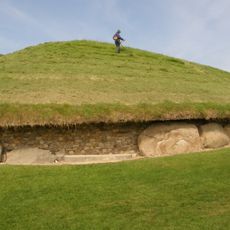
Brú na Bóinne is an archaeological complex along the River Boyne in County Meath, containing several burial mounds and stone structures from prehistoric times. The three main monuments—Newgrange, Knowth and Dowth—rise above gently sloping meadows and are surrounded by low walls, while many smaller mounds are scattered across the entire site.
Construction of the passage tombs began around 3300 BC and stopped around 2900 BC, centuries before the Egyptian pyramids. The site was reused in the early Bronze Age for henge building, then saw sporadic Iron Age burials near Knowth and Rosnaree. Roman coins and jewellery were left as votive offerings near Newgrange. Excavations began in 1962 under Michael J. O'Kelly, who worked at Newgrange until 1975.
The kerbstone before Newgrange's entrance carries a triple spiral found nowhere else at the site and repeated inside the chamber. The name Newgrange comes from new and grange, "farm", after the Cistercians of Mellifont Abbey acquired these lands in 1142. In Irish myth the tombs are portals to the Otherworld and dwellings of the Dagda and his son Aengus.
Visits inside the chambers are guided only, and spaces are limited, so arriving early in the day is worthwhile. The paths between mounds are easy to walk, but the site is large and you should allow a few hours to explore.
Each winter solstice morning, a narrow shaft of sunlight strikes the chamber floor in Newgrange for about 17 minutes. The alignment was calculated so precisely that the light still enters through the roof opening today, more than 5,000 years after construction.
The community of curious travelers
AroundUs brings together thousands of curated places, local tips, and hidden gems, enriched daily by 92,623 contributors worldwide.