Hirbat Hanut, Archaeological site in Valley of Elah, Israel.
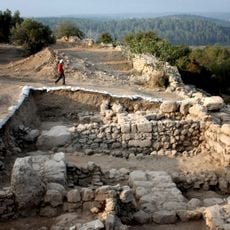
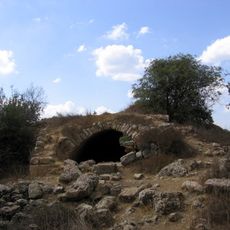
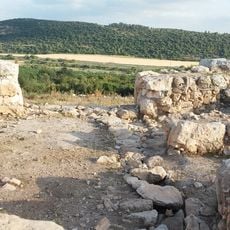
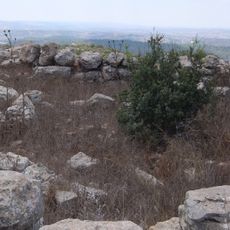
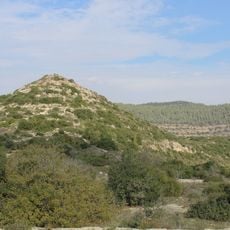
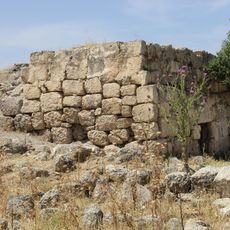
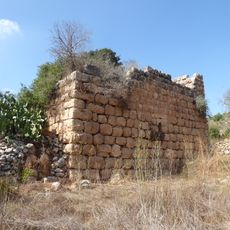
Hirbat Hanut is a ruin on the slopes of the Jerusalem hills about a kilometre west of Moshav Mata, where the hills give way to the Shephelah. Its centre is a Mamluk khan, a roadside inn on the Imperial Road, the Roman route from Jerusalem and Bethlehem to Beit Guvrin. Beneath it lie a 6th-century Byzantine church mosaic, a winepress and a reservoir.
A Byzantine church stood here in the 6th century, its mosaic dated by a Greek dedicatory inscription to 563, 568 or 593 CE; its walls likely collapsed in the mid-8th-century earthquake. In the Mamluk period a khan, a roadside inn, was built on the spot to serve travellers on the Imperial Road, the route from Jerusalem and Bethlehem to the Shephelah and Beit Guvrin. The inn stopped functioning during the Ottoman period.
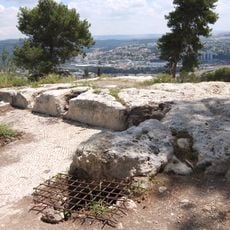
The name Hirbat Hanut comes from the Arabic Khirbat al-Khan, referring to the Mamluk-period khan (caravanserai) that served travellers on the Imperial Road. Visitors today uncover the Byzantine mosaic themselves: the Israel Antiquities Authority left the floor in place under sand, and a broom is provided so each visitor brushes it clear and covers it again. A Greek dedicatory inscription at the eastern end of the mosaic was damaged in 2012, when the floor was also defaced and slogans sprayed on the walls.
The site is outdoors and reached by marked trails starting from the parking area, so sturdy shoes are a good idea given the uneven ground. Spring and autumn tend to offer the most comfortable conditions for walking around.
The mosaic floor was left in place under a layer of sand rather than moved to a museum. A broom is kept in the building so visitors can sweep the sand aside themselves, look at the mosaics, and cover them again before leaving.
The community of curious travelers
AroundUs brings together thousands of curated places, local tips, and hidden gems, enriched daily by 94,474 contributors worldwide.