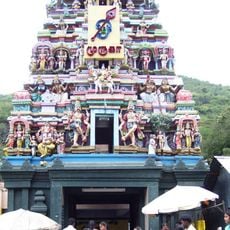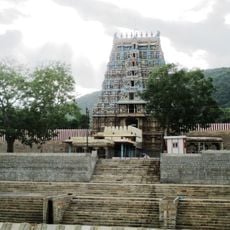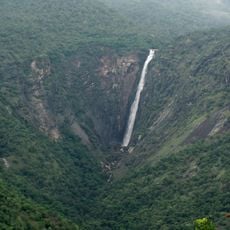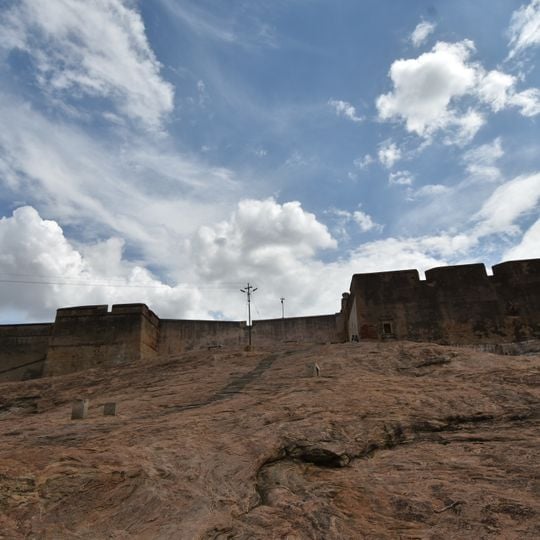
Dindigul Fort, Monument of National Importance in Dindigul, India.
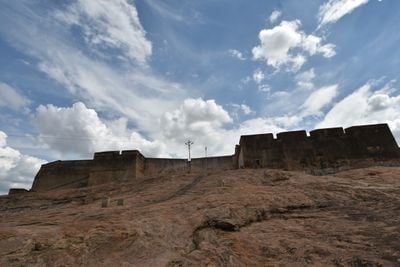
Dindigul Fort is a rock fort on a hill 900 ft (270 m) tall, with a circumference of 2.75 km. Its ramparts are built of dark weathered stone with a flat parapet and raised block merlons, a lower stepped bastion on one side and a taller squared tower mass on the other. A narrow worn path climbs the bare rock face to the wall. Inside are double-walled rooms, 48 former prison cells, a kitchen, a horse stable and a commanders' hall.
Muthu Krishnappa Nayak of Madurai built the hill fort in 1605, adding a fort at the foot of the rock. The Mysore army took Dindigul in 1742; Hyder Ali later strengthened the fort, and his son Tipu Sultan was crowned King of Dindigul in 1788. Tipu ceded Dindigul and the fort to the British in 1792, and British troops held the hill fort from 1798 to 1859.
The name Dindigul combines the Tamil words thindu (ledge or headrest) and kal (rock), after the bare hill the fort sits on. The Saiva poet Appar mentioned the city in his Tevaram works, and it appears as Padmagiri in Palupatai Sokkanathar's book Padmagiri Nadhar Thenral Vidu Thudhu. An abandoned temple stands on the summit, and cannons sealed with balls remain in the fort.
The Archaeological Survey of India maintains the site with visiting hours from 9:00 AM to 5:30 PM, charging nominal entrance fees for Indian nationals and modest fees for international visitors, while children under 15 enter free.
The fortress incorporates rainwater harvesting systems that capitalize on steep terrain and houses heavy cannons with sealed ammunition balls, demonstrating the military ingenuity employed in its 17th-century construction and defensive capabilities.
The community of curious travelers
AroundUs brings together thousands of curated places, local tips, and hidden gems, enriched daily by 94,158 contributors worldwide.