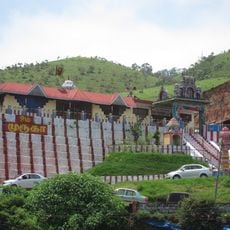
Dhandayuthapani Swamy Temple, Hindu temple on Palani hill, Tamil Nadu, India
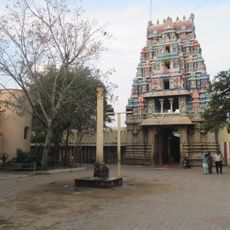
The Dhandayuthapani Swamy Temple stands atop a hillock in the Palani Hills. Its entrance has two carved pillars, a studded yellow door panel, and a blue signboard with Tamil script above the doorway. Inside, a ceilinged corridor leads to the sanctum, where the idol of Murugan is made of navapashanam, an amalgam of nine herbs or minerals.
The location appears as Thiruaavinankudi in the Sangam literature Tirumurukāṟṟuppaṭai, and the name Pothini, meaning 'big town with gold', later became Palani. A Chera king who ruled between the 2nd and 5th centuries CE restored the neglected idol after Murugan appeared in his dream, and built the hill temple. In the 10th century the Cholas expanded it, and their inscriptions record grants.
The name Palani derives from the Tamil phrase 'pazham nee', meaning 'you are the fruit', which Murugan is said to have uttered after renouncing the world. The temple is known for Panchamritam, a sweet prasadam of five ingredients that holds a Geographical Indication tag. Pilgrims carry kavadi, a physical burden, as a form of debt bondage; the first such kavadi, about 450 years old and made of wood and aluminium, is kept near Bogar's shrine.
Two foot routes lead up the hillock: the elephant path, easier for the ascent, and another path used for the descent. Pilgrims can also ride a winch-operated railway or a rope car to the top. The temple is managed by the Hindu Religious and Charitable Endowments Department of Tamil Nadu.
The temple prepares Panchamritam daily, a sacred mixture of five ingredients distributed as prasadam to thousands. The recipe has remained unchanged for centuries, following exact proportions guarded by temple priests.
The community of curious travelers
AroundUs brings together thousands of curated places, local tips, and hidden gems, enriched daily by 92,678 contributors worldwide.