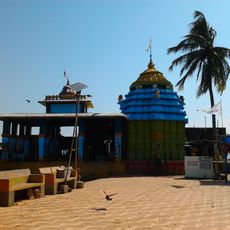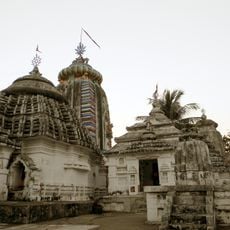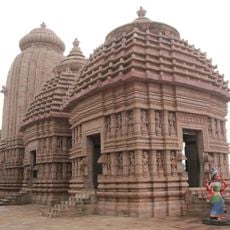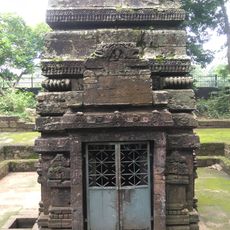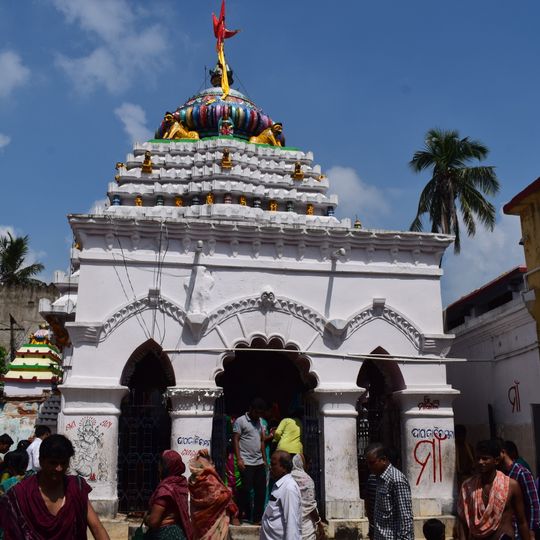
Akhandalamani Temple, Hindu temple at Aradi village, Bhadrak district, India.
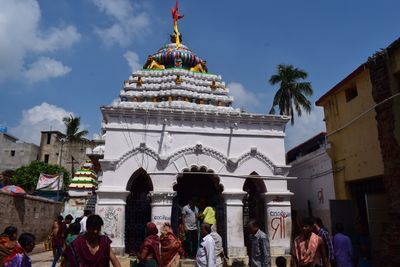
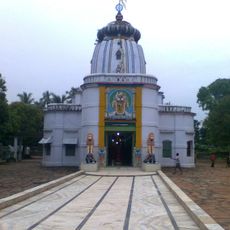
Akhandalamani Temple is a white Shiva shrine in Aradi village, Bhadrak district, on the bank of the Baitarani River. Its stepped, tiered superstructure is crowned by a rounded, multi-coloured dome-like finial topped with a tall red flag. The facade has a large central arched entrance flanked by two smaller arches, with a scalloped moulding above the main arch and black and red painted script on the base walls.
A farmer discovered a black stone producing milk instead of blood while plowing, prompting King Niladri Samara Singha Mohapatra to establish this temple. The shrine was constructed in the early 1800s between 1830 and 1840.
The village name Aradi comes from the cry "Aa" said to have been uttered when the lingam appeared. During Sravana, Bol Bam pilgrims carry holy water from rivers such as the Ganges, Baitarani, Mahanadi and Salandi on bamboo levers. Mahasivaratri is held here as the Jagara mela, drawing devotees from inside and outside Odisha.
The temple lies 37 km east of Bhadrak via Asurali, Kothara and Dhusuri, and the PWD road from Bhadrak to Aradi is now an all-weather State Highway. From Chandabali ferry ghat, boats reach Aradi in about two hours along the Baitarani. A Pantha Nivas built by the Odisha Tourism Department provides lodging at Aradi.
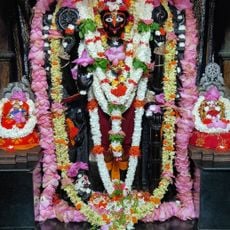
The lingam inside the sanctum measures 33 inches high with a circumference of 45 inches; the goddess Shakti's is 52 inches around. The temple's stone blocks were floated down the Baitarani from Nilagiri hill, about 100 km away, and a canal called Shiba Mahara was dug to move them.
The community of curious travelers
AroundUs brings together thousands of curated places, local tips, and hidden gems, enriched daily by 93,862 contributors worldwide.