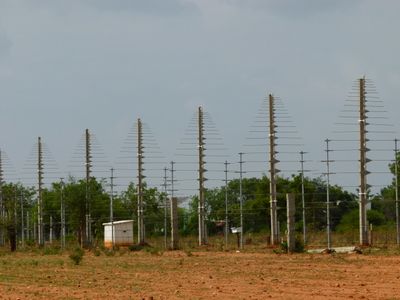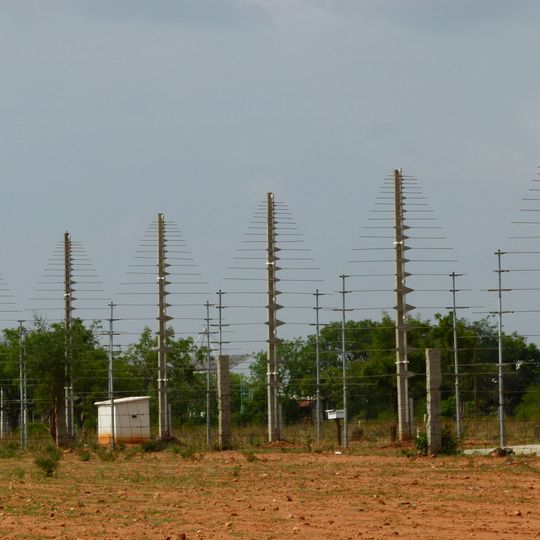
Gauribidanur Radio Observatory, Radio astronomy research center in Gauribidanur, India.
Gauribidanur Radio Observatory is a radio astronomy facility near the town of Gauribidanur in Karnataka, India. It consists of a large T-shaped antenna array spread across open land, designed to receive and analyze radio signals from space.
The site was set up in 1976 to install the Gauribidanur Telescope, a 1000-dipole array in a T-shaped layout, and it has monitored the Sun and pulsars since then. Its solar work at decametre and metre wavelengths continues antenna-array observations begun in the early 1950s at Kodaikanal under the Kodaikanal Yale project. The observatory is operated jointly by the Raman Research Institute and the Indian Institute of Astrophysics.
The site's name comes from the town of Gauribidanur in Chikkaballapur district, and its solar radio work continues a series of decametre and metre wavelength observations begun in the early 1950s at Kodaikanal with Yagi arrays under the Kodaikanal Yale project. The 1.4 km east-west arm and 0.5 km south arm of the telescope lie across open ground.
The site is about 100 kilometers (60 miles) north of Bengaluru, reachable by road in a couple of hours. Because it is an active research facility, visits require prior arrangement with the managing institutions before arrival.
The observatory was among the first in the world to produce two-dimensional maps of radio emissions from the solar corona, which is the outer layer of the sun. This approach gave scientists a way to study the structure of the corona that optical instruments alone cannot provide.
The community of curious travelers
AroundUs brings together thousands of curated places, local tips, and hidden gems, enriched daily by 94,045 contributors worldwide.