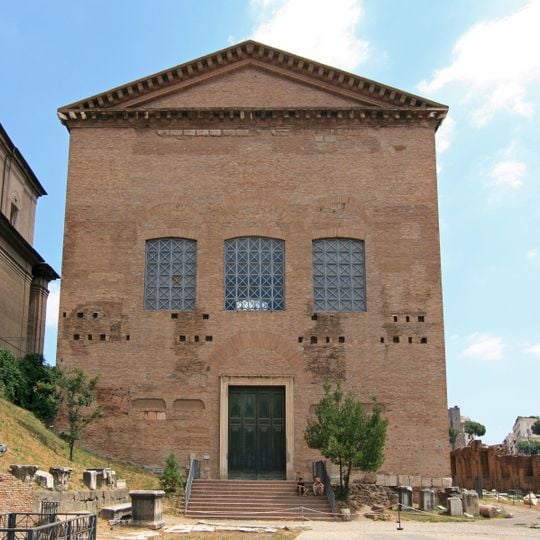
Curia Julia, Ancient Roman Senate house in Roman Forum, Italy
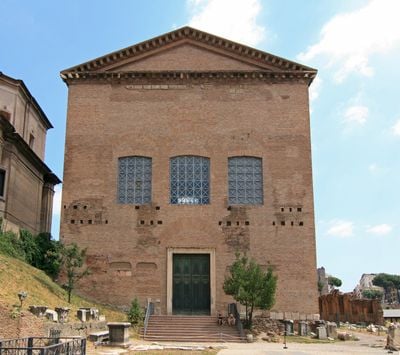
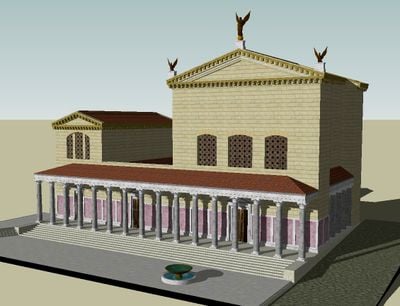
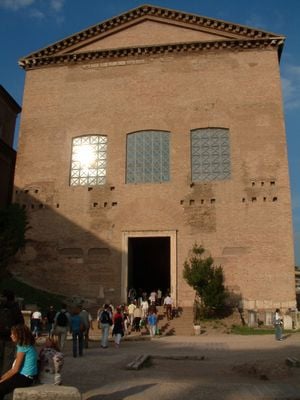
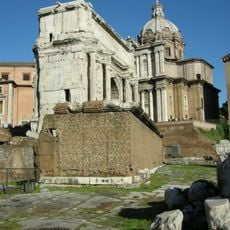
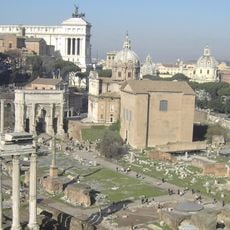
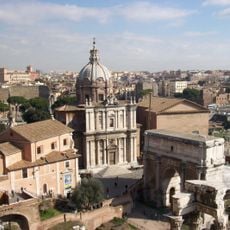
The Curia Julia is a brick structure in the Roman Forum where the senate convened. The facade shows heavy corner supports and three broad windows beneath the roofline, while bronze doors mark the entrance.
Julius Caesar began the Curia Julia in 44 BC to replace the Curia Cornelia, which had been damaged by fire in 52 BC. Work stopped after Caesar's assassination and was completed by Augustus in 29 BC. The building was restored under Domitian in 94 and rebuilt by Diocletian after a fire in 283. In 630 it became the church of Sant'Adriano al Foro, and in the 1930s it was deconsecrated and restored to its ancient appearance.
The name curia meant simply "meeting house"; this one took its name from the curiae, the citizen groups that assembled in the adjoining Comitium. In the 6th century the building was still used by the Senate under Theodoric, but under the name Atrium Libertatis, borrowed from a neighbouring building where slaves were freed. In 630 Pope Honorius I turned it into the church of Sant'Adriano al Foro, decorated with Byzantine frescoes still partly visible on the inner facade.
Visitors can observe the replica bronze doors at the entrance, while the originals are now kept at the Lateran Basilica. The interior shows tiered seating areas along the walls, making the layout of the chamber visible.
The floor's opus sectile was partly reconstructed with ancient marbles, laid out as in Diocletian's time: rosettes in squares alternate with paired cornucopias in green and red porphyry on yellow Numidian and purple Phrygian stone. The original scheme is known from Claridge's description, so the pattern seen today follows the late-antique arrangement rather than Caesar's floor.
The community of curious travelers
AroundUs brings together thousands of curated places, local tips, and hidden gems, enriched daily by 93,343 contributors worldwide.