Roman Amphitheatre of Ancona, Roman amphitheatre on Guasco Hill, Ancona, Italy
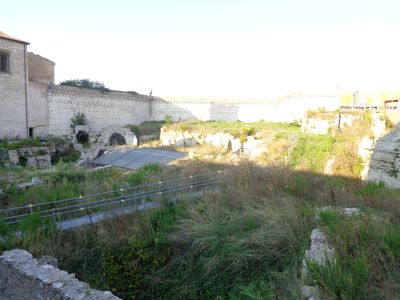
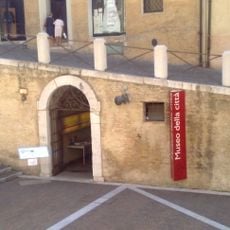
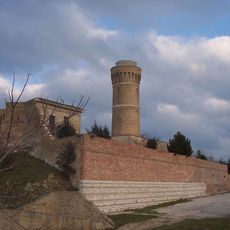
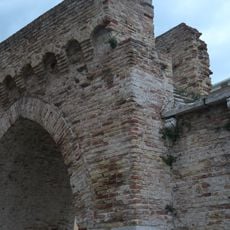
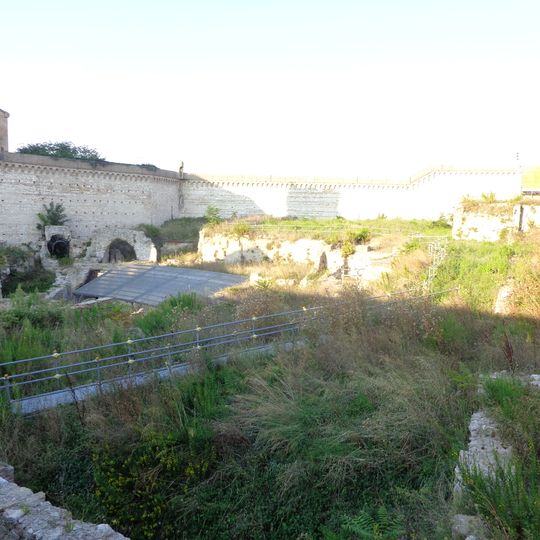
The Roman Amphitheatre of Ancona sits on Guasco Hill and was built with multiple stepped levels to accommodate large public events. The ruins still show the stone structures and access passages that cut into the hillside.
The amphitheatre was built into the saddle between Colle Guasco and Monte Cappuccini, its cavea resting on cut marly rock to the north-east and on concrete vaults to the south-west. A mosaic inscription names the duumvirs Publius Hortorius Scaurus and Gaius Caesius, son of Sextus, who had the adjoining building erected by decree of the decurions with public money. In 2025 the archaeological park joined Italy's national museum network under the Direzione regionale dei Musei delle Marche, bringing regular public opening and renewed excavation.
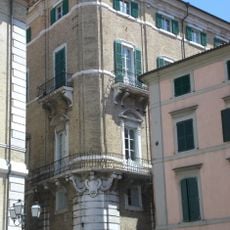
Locals call the main arena entrance "Arco Bonarelli", after the noble family whose palace stood here. The building attached west of it, with a small pool (natatio) and mosaic floors showing a chessboard, two dolphins and a dedicatory inscription, was a gladiator school or bath complex; the inscription names the duumvirs Publius Hortorius Scaurus and Gaius Caesius.
Visits are possible only through advance group reservations arranged with the regional cultural authority. It is advisable to book early and wear comfortable shoes, as access involves uneven terrain.
The mosaic floor of the building beside the porta pompae carries a Latin dedication naming the duumvirs Publius Hortorius Scaurus and Gaius Caesius, son of Sextus, who had it built with public money by decree of the decurions. The pavement shows a checkerboard, two dolphins and a trachyte circle. Below it, excavation reached a street from the Greek colonial period.
The community of curious travelers
AroundUs brings together thousands of curated places, local tips, and hidden gems, enriched daily by 93,984 contributors worldwide.