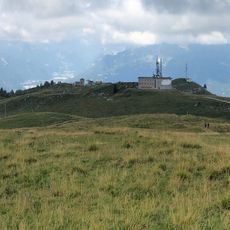
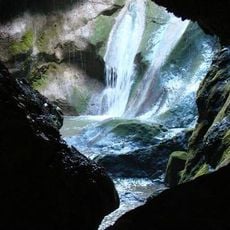
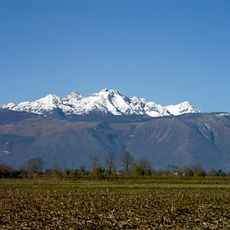
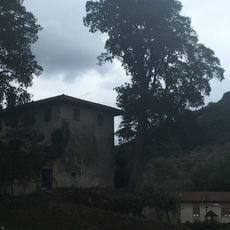
Bus de la Lum, Karst sinkhole in Caneva, Friuli-Venezia Giulia, Italy
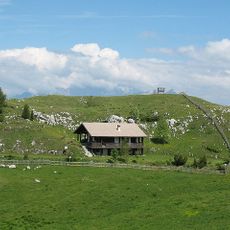
Bus de la Lum is a karst sinkhole on the Cansiglio plateau, in the municipality of Caneva, Friuli-Venezia Giulia. It consists of a single sheer shaft about 187 m deep with no branches; at -60 m a precarious debris pile makes descent difficult, and a side cave at the bottom is blocked by rubble. Since 1981 the adjacent Pozzo dei Bellunesi joins it at -180 m, forming one speleological complex.
During the final months of World War II, partisans active on the Cansiglio used the sinkhole to dispose of bodies of soldiers of the Italian Social Republic and German troops, as well as civilians. A 1949 Carabinieri report from Vittorio Veneto counted over 300 victims, while 1960s speleologists suggested up to 500; about 28 remains were recovered in 1950 and a few bones in 1992, reburied at the Caneva cemetery.
The name derives from the light that filters into the opening at certain times, creating notable visual effects within the shaft. Local stories speak of supernatural beings connected to such places, shaping how people view this natural feature.
When planning a visit, pay attention to weather conditions as rain can make access difficult and the surrounding ground unstable. The best time to explore is during drier periods when conditions are safest for movement around the opening.
The Pozzo dei Bellunesi, found in 1981, joins the main shaft at a depth of 180 metres, not 80, so the whole complex is now called Bus de la Lum - Pozzo dei Bellunesi. The 1924 survey put the bottom at 225 metres; the Salone della Lanterna, rediscovered in 1992, is the true deepest point at 187 metres.
The community of curious travelers
AroundUs brings together thousands of curated places, local tips, and hidden gems, enriched daily by 93,520 contributors worldwide.