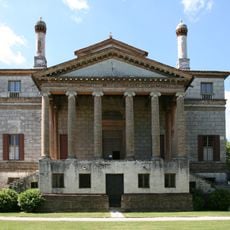
Ca' Sugana, Palace and Italian national heritage in Treviso, Italy.
Ca' Sugana is a neoclassical palace on Via Municipio in central Treviso. Its ground and mezzanine walls are dressed with rusticated stonework, pierced by a large round-arched portal and two rows of four rectangular windows on each side. The piano nobile has a Palladian window above the portal, the second floor simple rectangular windows with three grouped at the centre, and a small pediment with a blind oculus crowns the main facade.
The Sugana family commissioned this palace in the early 1800s as a private residence reflecting the architectural tastes of their era. In 1868 it was converted to serve as the official seat of Treviso's municipal government, a role it continues to fulfill today.
In the atrium, on the left as you enter, Giambattista Canal painted frescoes of coats of arms, festoons and figures. At the foot of the staircase, two plaques commemorate the podestàs Giuseppe Olivi and Luigi Giacomelli. The large canvases, tapestries and paintings upstairs, by Nicola Delin, Gregorio Lazzarini, Rosa Bortolan and Luigi Serena among others, were placed here by the municipality to decorate the reception rooms and do not date from the Sugana period.
Ca' Sugana stands on Via Municipio in Treviso's historic centre, a short walk from Piazza dei Signori. It is the working seat of the city council, so the atrium and staircase are best visited outside council sessions and office hours. The 1934 wing opens onto an internal courtyard on the right of the facade.
The entrance level features a Palladian-style window design that differs distinctly from the regular window arrangements on the upper floors above. This architectural contrast creates a memorable visual hierarchy that distinguishes this building from other neoclassical structures in the city.
The community of curious travelers
AroundUs brings together thousands of curated places, local tips, and hidden gems, enriched daily by 92,600 contributors worldwide.