Castello di Pentefur, Medieval castle ruins in Savoca, Italy
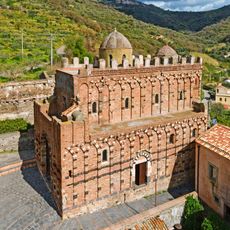
Castello di Pentefur stands on the flat top of a hill above Savoca. Its trapezoidal base encloses stretches of Guelph-merloned walls with arrow slits, several cisterns and the remains of a two-storey quadrangular keep covering 350 m², where traces of rooms and floors from the 7th to the 17th century survive.
The present structure is a 12th-century rebuilding ordered by King Roger II of Sicily. It became the summer residence of the Archimandrite of Messina, feudal lord of the Barony of Savoca, who stayed there with his court; the castle also had a chapel, now the Church of San Michele. In 1355 King Frederick IV declared it a Royal Castle, removing it from the Archimandrite's control and granting it to Guglielmo Rosso, count of Aidone.
The name Pentefur probably comes from the Greek pente fylè, five districts, recalling Byzantine Savoca's five quarters; a medieval legend instead credits five robbers escaped from Taormina's prison. From the castle, orders went to lookout towers along the coast, among them those designed by Florentine architect Camillo Camilliani where Santa Teresa di Riva, Furci Siculo and Roccalumera now stand.
The site is accessible through Via Chiesa Madre and has been made available to visitors thanks to restoration work carried out by the Nicòtina family. Visitors should expect uneven ground and exercise caution near the ruined walls.
Local legends speak of five fugitives from Taormina who supposedly built the castle, and the name Pentefur may derive from the five districts of ancient Savoca. This tale connects the building to the early settlement patterns that shaped the area.
The community of curious travelers
AroundUs brings together thousands of curated places, local tips, and hidden gems, enriched daily by 94,329 contributors worldwide.