Capocotta, Protected coastal area near Rome, Italy.
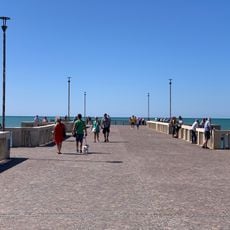
Capocotta is a 45-hectare beach of dunes between Castel Porziano and Torvaianica, along the Litoranea road (SP 601) at kilometres 8 to 10, part of the Litorale Romano State Nature Reserve since 1996. It is a free-access beach with kiosks run under concession from Rome, and it holds Italy's first authorised naturist oasis, opened in 2000.
The Capocotta estate, probably first called Capocorso, is documented as an autonomous entity in the 15th century under Camillo Capranica, then passed to the Borghese in the 17th century; the 1803 land register recorded about 760 hectares. At the start of the 20th century it became private property of the Royal House to enlarge Castelporziano. In 1985 President Sandro Pertini had 1,000 hectares annexed to the presidential estate, halting a planned residential district.
This beach section has served for decades as a gathering space for Rome's LGBT community and is experienced by many as a place of freedom and acceptance. People from different backgrounds come here to relax and be themselves without judgment or restrictions.
The reserve can be accessed through numbered gates that lead to different beach sections suited for various activities. The best time to visit is outside peak summer months when the beach is less crowded and the natural surroundings are more comfortable to explore.
The body of Wilma Montesi was found on the beach in 1953, giving rise to the Montesi case, which inspired scenes in Federico Fellini's La dolce vita and is cited in Rino Gaetano's 1978 song Nuntereggae più. Pier Paolo Pasolini also used the beach for one of his "corsair" interviews in the 1970s.
The community of curious travelers
AroundUs brings together thousands of curated places, local tips, and hidden gems, enriched daily by 92,718 contributors worldwide.