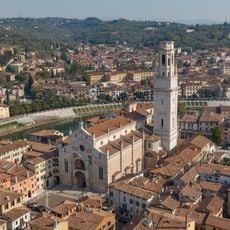
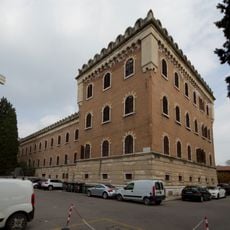
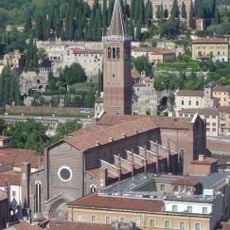
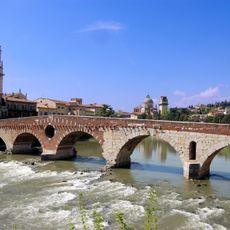
Santi Siro e Libera, Church building in Verona, Italy.
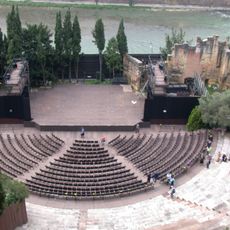
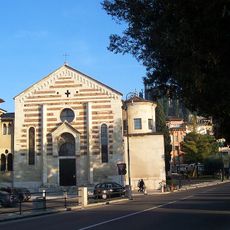
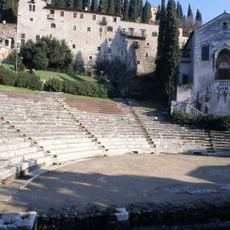
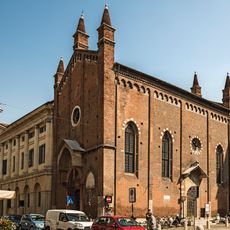
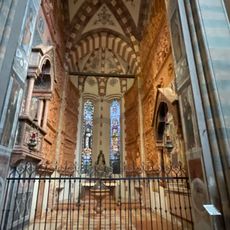
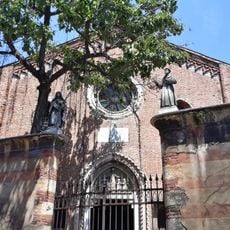
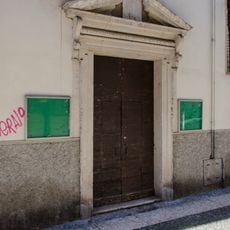
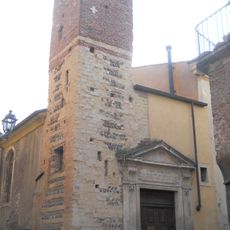
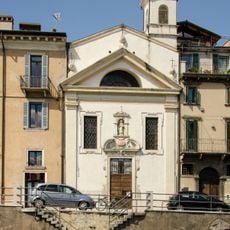
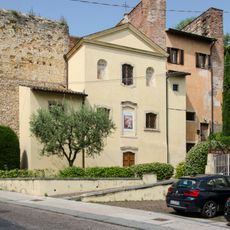
Santi Siro e Libera stands on Roman substructures at the top of the cavea of Verona's Roman theatre, so its trapezoidal plan, with side walls splaying toward the presbytery, follows the ancient masonry. The west facade has a two-branch staircase, a pointed-arch portal with a frescoed lunette under a hanging prothyrum, and a Roman-era plaque in the right corner. Inside is a single hall with an Ionic order, two side chapels and a flat-ceilinged choir.
The church was built in 913 by Giovanni, bishop of Cremona and chancellor of Emperor Berengario, above an archway of the Roman theatre where Verona's first Mass is said to have been celebrated. In 922 he donated it to the Benedictine monastery of Santa Maria in Organo. A 14th-century Gothic remodelling left only the portal, the hanging porch and its frescoes. The Confraternity of the Most Holy Sacrament, granted the church in 1517, had it enlarged in 1613 by incorporating Santa Maria della Cava; side chapels followed between 1672 and 1703.
The church is dedicated to Saint Siro and Saint Libera, reflecting how this place has served the local Catholic community across different eras. Visitors can observe how the spaces remain organized for worship and religious gatherings today.
Visitors should know this is an active place of worship, so access may be limited during religious services and ceremonies. It makes sense to visit during quieter times to view the interior and decorations without interruption.
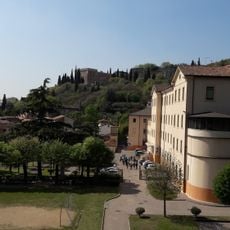
The church stands on the substructures of the Roman theatre, at the highest point of the ancient cavea, so its trapezoidal plan with walls splaying toward the presbytery comes from reusing those antique structures. The choir stalls were carved by German artists between 1717 and 1720, and the painter Giambettino Cignaroli is buried here.
The community of curious travelers
AroundUs brings together thousands of curated places, local tips, and hidden gems, enriched daily by 92,987 contributors worldwide.