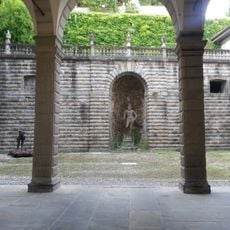
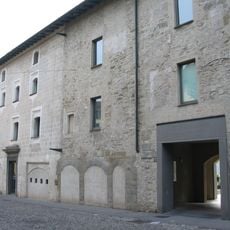
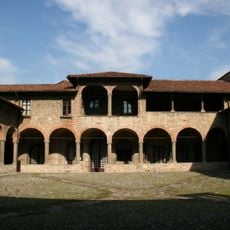
San Michele al Pozzo Bianco, Renaissance church in Upper Bergamo, Italy.
San Michele al Pozzo Bianco is a Renaissance church in Bergamo with a single nave divided by three bays supported by fifteenth-century pillars. Pointed arches frame the space while exposed wooden beams overhead reveal the original building technique.
The structure dates to the eighth century during Lombard rule, with its earliest documented record in Taidone's will from 774. This founding period establishes it as a key witness to early medieval Bergamo.
The name refers to a white marble well that once stood nearby; the church was already called "Pluteo Albo", meaning white well, in the 10th century, and the epithet appears in documents after 905. A lay confraternity founded in 1226 cared for the needy here until its suppression in 1805, when its works were dispersed, many to the nearby church of Sant'Andrea.
The entrance has two small steps to navigate, and coins are needed to activate the lighting system to view the artworks inside. Bring small change and consider carrying a flashlight to see the frescoes clearly.
The oldest part of the building is probably the scurolo, the lower chamber reached by a staircase, whose thirteenth-century frescoes include an Enthroned Madonna and Saints attributed to Antonio Boselli. The church was consecrated in 801 under Charlemagne, and the name Pozzo Bianco appears only in documents after 905.
The community of curious travelers
AroundUs brings together thousands of curated places, local tips, and hidden gems, enriched daily by 92,796 contributors worldwide.