Fortified city of Bergamo, Defensive walls in Città Alta, Bergamo, Italy
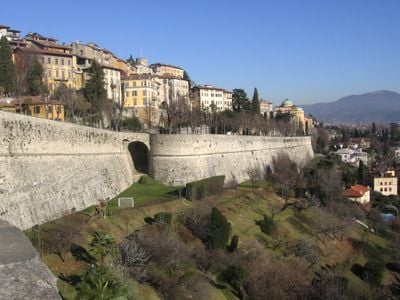
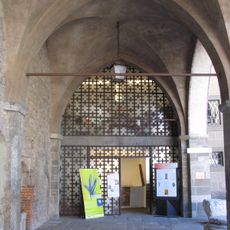
The Venetian Walls of Bergamo run for 6,200 metres around the upper city, built from 1561 to 1588 with 14 bastions, two powder magazines and four gates: Sant'Agostino, San Giacomo, Sant'Alessandro and San Lorenzo, also called Porta Garibaldi. Of the 32 sentry boxes only one survives. The walls are made of rough-cut stone blocks laid in visible courses, with a flat top edge and a rounded arched gateway set deep into the masonry.
Venice began the walls on 31 July 1561, when Sforza Pallavicino arrived with engineers Gerolamo Martinengo, Agostino Clusone and Giulio Savergnano. About 250 buildings were demolished, including the church of Sant'Alessandro; in 1621 a granite column was set by the gate to mark the site. The works, led after 1585 by Giulio Savorgnan, ended in 1588 at a cost of one million ducats.
The walls shape how the old town looks and feels, marking the boundary between two distinct parts of Bergamo. People today still move through the same gates their ancestors used, making the fortifications a living part of daily life.
You can walk the entire perimeter on marked paths that offer views across the Po Valley and toward the Alpine peaks. The routes are open to the public and let you explore the full circuit at your own pace.
Construction devoured about 250 buildings on the edge of the upper town, and on the night of 1 August 1561 some 80 more were razed, among them the Dominican monastery of Santo Stefano and 24 churches. The church of Sant'Alessandro, the city's first Christian temple, fell too; a granite column near the gate of the same name, set up in 1621, marks the spot.
The community of curious travelers
AroundUs brings together thousands of curated places, local tips, and hidden gems, enriched daily by 92,886 contributors worldwide.