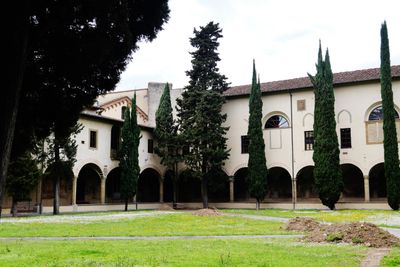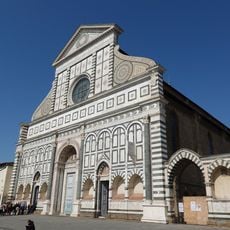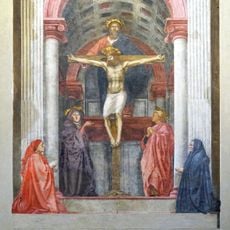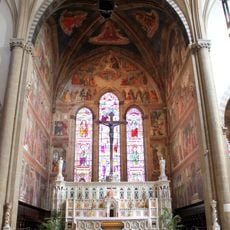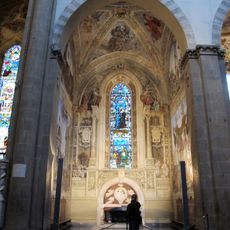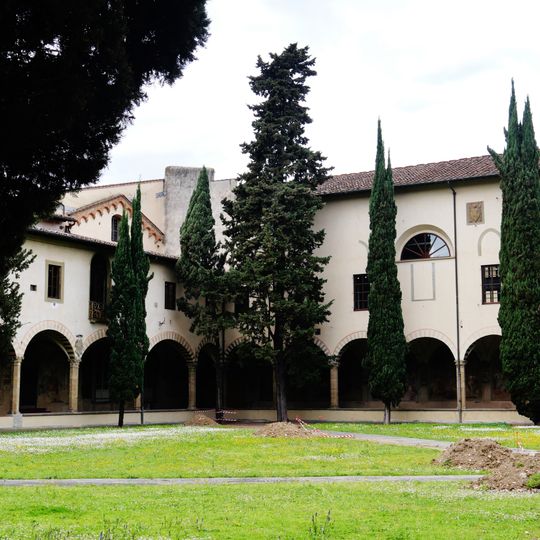
Chiostro Grande of Santa Maria Novella, Medieval cloister in Santa Maria Novella complex, Florence, Italy.
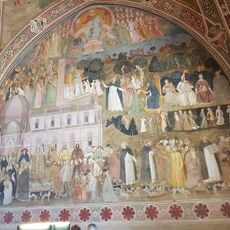
The Great Cloister of Santa Maria Novella is the largest cloister in Florence, built between 1340 and 1360. It has 56 round-arched arcades on pietra serena pillars, with arches painted in black-and-white stripes imitating polychrome marble. Above the arcades are 60 lunettes, 53 of them frescoed with Stories of Christ and Dominican saints by Florentine painters between 1581 and 1584.
The cloister was built in the middle of the 14th century as part of the monastery, and later it was redesigned in the 16th century by architect Giulio Parigi at the request of a powerful family. These renovations gave the space its current form and updated it to match the artistic tastes of the time.
The frescoed lunettes carry cartouches at the top centre with descriptions of each scene, from which the works' simplified titles are taken. The cycle runs clockwise from the south-west corner near the Chapel of Saint Nicholas, beginning with the Nativity, then the Stories of Saint Dominic interleaved with episodes from the life of Christ along the west and north sides.
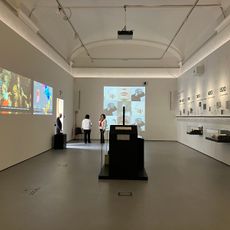
The cloister is part of the Santa Maria Novella museum complex and has been open to the public since 2012. Access is through the museum; the courtyard is on the ground floor, with the arcade and frescoed lunettes at eye level. The north and west sides, with the most important frescoes, have been restored after the 1966 flood, while work on the other sides continues.
The western side of the cloister shows a rare arrangement where scenes from Saint Dominic's life are painted directly alongside scenes from Christ's life in matching positions. This side-by-side comparison allows you to see thematic connections between the saint's journey and the religious narrative in a way you might not immediately notice elsewhere in the complex.
The community of curious travelers
AroundUs brings together thousands of curated places, local tips, and hidden gems, enriched daily by 92,746 contributors worldwide.