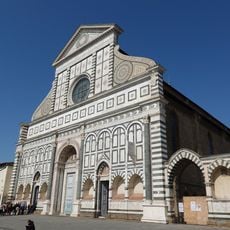
Chiostro dei Morti, Cloister in Santa Maria Novella complex, Florence, Italy
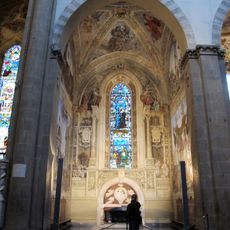
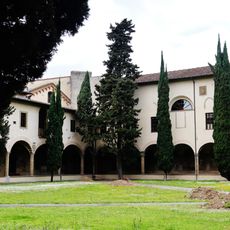
The Chiostro dei Morti is the oldest cloister of the Santa Maria Novella complex. Two sides have lowered cross vaults on octagonal pillars with an overhanging gallery supported by projecting corbels, linking the former dormitory to the sacristy. The east side is divided into deep chapels, including those of Saint Anthony Abbot, Saint Anne and Saint Paul, and a corner chapel of the Annunciation.
The cloister originally dates to the 13th century but underwent major reconstruction between 1337 and 1350 following flood damage. Fra Jacopo Talenti directed these rebuild efforts, which shaped the space as it appears today.
The name "dei Morti" comes from the cloister's centuries-long use as a cemetery, also called the lower or underground cemetery because it lay below the level of the church. Funeral coats of arms, many from the 14th century, cover the walls, with mostly 19th-century tombstones aligned below them. In the corner, the Cappella dell'Annunciazione, the former Strozzi burial chapel, keeps two frescoed walls attributed to Andrea Orcagna.
The cloister is part of the basilica museum and can be visited as part of the main complex. It helps to start exploring the chapels on the eastern side and then move slowly around the square space to take in the details.
The name refers to its former function as a cemetery for Dominican friars, whose graves lay beneath the church level. This burial practice was central to how the community used the space for several centuries.
The community of curious travelers
AroundUs brings together thousands of curated places, local tips, and hidden gems, enriched daily by 93,005 contributors worldwide.