Fountain, Fountain in Parioli, Rome, Italy
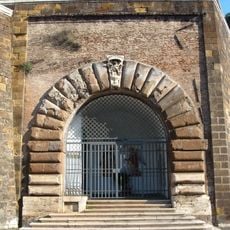
Fontana dell'Acqua Acetosa sits below street level in the Parioli quarter, reached by a staircase that descends to an exedra-shaped façade. Three niches are cut into it, each holding the Chigi coat of arms — six mountains under an eight-pointed star — above a small basin fed by a pipe. A tympanum at the top carries the papal coat of arms and a plaque.
The ferruginous spring here was analysed in 1613 under Paul V and found curative for kidney, stomach, spleen and liver ailments. Paul V had Giovanni Vasanzio build a fountain in 1619; Innocent X restored it, and Alexander VII commissioned the present exedra fountain. Clement XI ordered a restoration in 1712 after complaints about low flow and poor water quality.
The name comes from the ferruginous water once sold in the city by street vendors called acquacetosari, first recorded by Papi in De agricoltura (1663). Each of the three niches carries the Chigi coat of arms, six mountains under an eight-pointed star, above a small basin fed by a pipe. The stone seats date from 1821, paid for by Ludwig I of Bavaria, who met his lover Maria Anna Florenzi here.
The fountain sits below street level in the Parioli quarter, reached by a staircase, so visitors descend to the exedra façade. It can be reached from the Acqua Acetosa station. Since 2008-2009 a small fenced park surrounds the area, restoring its original setting.
The stone seats along the fountain were funded in 1821 by Ludwig I of Bavaria, who often stayed in the area during his Roman sojourn; it was here that he met his lover Maria Anna Florenzi. The fountain was closed in 1959 because the aquifer was polluted, and it later reopened fed by ordinary mains water.
The community of curious travelers
AroundUs brings together thousands of curated places, local tips, and hidden gems, enriched daily by 93,119 contributors worldwide.